Showing posts with label pathology. Show all posts

Tuesday, April 24, 2012

When Others Don't Like The 'P' Word


by Sandra L. Brown, M.A.

I was recently asked to be on a national TV show to discuss the issue of psychopathy in relationships based on my book 'Women Who Love Psychopaths.' They had looked at the website, read information about the book, discussed what the rest of the show was going to be about, and booked me for the show. They didn't invite me based on my other book (although equally as informational) How to Spot a Dangerous Man, they booked me to discuss and showed the book cover of, Women Who Love Psychopaths.

However, 20 minutes before going on air a producer told me 'they' (whoever that is in TV world) was uncomfortable using the 'p' word--psychopath. They found the word to be 'controversial' and 'sensationalistic' and that my example of probably well known public psychopaths who are not recognized as psychopathic was too debatable and unproveable to discuss.

This was of course sad for me to hear since so much of what The Institute attempts to provide is public pathology education. Truly the only way for people to avoid psychopathy is to develop the ability to understand the traits and learn to spot it in others. All which is why our goal for this agency is public education. This is of course, not our first time to hear that the 'p' word is offensive, debatable, controversial, or judgmental, and it will not be the last time, unfortunately.

Several victims of incredible psychopathic abuse were also on the show and I was asked to comment on their cases but also asked to not use the 'p' word. I asked the producer what she thought those perpetrator's behaviors should be called, or what disorders would motivate their behavior....or what was she suggesting I 'should' call them? I told her I was at a loss to pick another label or motivation behind their lethal behaviors that would come close to helping others understand 'who does that?'. I told her that psychopathy was a diagnosis, not merely a political argument, a theoretical ideology, or even a criminal judgment of character. I was confused as to why I was there when what I do, what I write about, who I help, and who I help convict are overtly obvious from my professional background and from our website.

I was reminded again when I heard 'the p word' is controversial, that public pathology education is still in it's infancy. I know that victims face this all the time when they struggle to figure out what is wrong with the pathological person, only to discover the shocking revelation of the person's disorder. But the victim trying to teach others what is wrong with the pathological is counteracted when others find the information to be disputable, distasteful, unproveable, unlikely, and un-spiritual to even suggest.

The 'p' word is now viewed as the new psychological slur of the 21st century. It's correlated with the devastating racial slurs of the 1950's, the cultural slurs of the 60's-70's, and the gay/lesbian slurs of the 80's-90's. Now, we face the 'p' word the way we faced the 'n' of the 50's and the 'f' or the 60'70's and the 'q' of the 80-90s. But with a huge difference! There is nothing wrong with the 'p' word the way it was intensely wrong with the 'n,' 'f,' and 'q' words of decades gone by.

But it is treated as if we are being racially insensitive, culturally inappropriate, or gender ignorant. We are looked at as the skin-heads of the Diagnostic Statistical Manual that we would 'dare' to 'call someone' a psychopath. We are viewed as the rock throwers at the psychologically-disabled
people with pathology, the Bible thumpers of the poor spiritually disenfranchised psychopath, and the socially clueless that we would spew a power-packing psychological label like 'psychopathy' around that might actually strike and land on a human being.

I know, I know....afterall, it's daytime TV which we all recognize is about ratings and keeping pace with society's Attention-Deficit-Disordered need for topics to be covered in three minutes no matter how riveting the storyline is. Daytime TV covers tsunamis of natural science as well as the tsunamis of psychological trauma in the same fast fall swoop of selling hair dye and lipstick in the same 30 minute segment. What did I expect afterall?

...Well, I always hope that a victim's trauma is recognized and embraced for the emotional and spiritual strength it took to not only survive, but to show up on that TV stage to tell their story to help others. ...Well, I always hope that the need to teach others 'how to spot' the devastating disorders that created the victims trauma is the guiding motivation behind why TV shows exist and supercedes the mere 'storyline-as-business' of TV.

Yes, I recognize that daytime TV is not the spokes person for the planet--that there ARE those who really want to hear more of the victims story and learn more about 'how to spot' them in their own lives....but I have to tell you, it IS a 'cold-water-splash-in-the-face', like a 'wake-up-Sandra-we-aren't-as-far-as-you-think' call that we are whispering the 'p' word behind stage and off camera and are 'editing it out' for public viewing. The whole segment of discussion about low empathy, no conscience and "who does that" was removed. Not one word that explained the behavior of those lethal people was 'leaked' to the viewing audience for public pathology education. We still have miles and miles to go in educating the public that psychopathy is a disorder not a verbal tyriad.

You know what....as offensive, debatable, controversial, judgmental, OR .... as disputable, distasteful, unproveable, unlikely and un-spiritual as it felt to those merely producing a nano-second based TV show to say the 'p' word, the victims who have lived with the 'p' are the true authorities here. They would probably beg to disagree with the nay-sayers that the 'p' is a profound psychological slur. I am sure the victims found the 'p's behavior to be more offensive than TV-land will ever understand. The victims surely wrestled with their own need to over come the 'debatable-ness' of the disorder, or the controversy that swirled around the lethal behaviors of the psychopath and I am sure the victim's incured their own judgmental views of outsiders. I doubt today the victim's find their story to be un proveable or even disputable ---after all, some of these storys ended up in murder or attempted more. All adjectives that are associated with psychopathy.

As 'controversial' as TV-land felt the 'p' word was, does not even compare to the victim's overwhelming need to shout from the roof-tops what the pathological IS....a psychopath.

Using the 'p' word of psychopathy is not a slur. It is a education, a prevention, a DIAGNOSIS, and the reality for millions of victims in the world.

Sandra L. Brown, M.A. is the Founder and CEO of The Institute for Relational Harm Reduction and Public Pathology Education.  She is the author of several best selling books, including How to Spot a Dangerous Man and Why Women Love Psychopathswww.saferelationshipsmagazine.com


Thursday, November 24, 2011

Judge William Adams, A Camera, and the Power of Light


By Roger A. Canaff, JD 


Roughly 2000 years ago an itinerant rabbi gave a sermon about light. The right thing to do with a lamp, said the rabbi, was to let it shine, not put it under a basket. That made sense in a time where light after sunset was a luxury; hence the parable. And of course, in the spirit of parables, there are other forms of light, and other functions for what we know as light. Light illuminates, and in so doing exposes.

In 2004, a remarkable young woman with a disability shined a light in the form of a video camera on the pathology, hatefulness and pure evil of a man who, until recently, had been a sitting judge in Texas. The video shows him, her father, beating her with a belt in a breathtakingly brutal way, over seven interminable minutes.

I am using words like “pathology” and “evil” distinctly, although as the study of psychology evolves, the difference between what we might call mental illness and what we have historically called evil are blurring in ways that make people like me- prosecutors, and arbiters of legal blame- uncomfortable. But for now, I’m comfortable, perhaps recklessly so, with discussing the two separately. I believe the man is probably sick. I also believe he’s evil.

Millions have seen the video. Millions more, thanks in part to the appropriate “trigger” warnings that have been associated with it, have demurred. I watched every second of it, and more than once. The video’s subject is my job, after all; I have seen things far worse, but in many ways I haven’t seen anything quite as naked and telling as this. Because sometimes it takes a camera in the right place at the right time to truly expose what lies beneath far more facades of normalcy than most of us understand. A camera won’t flinch. It won’t turn away. It will simply record with passive silence, and in situations like this one perhaps its growing ubiquity in our lives is a positive thing. After all, it allowed a 16 year-old Hillary Adams to preserve something that is simply unbelievable to many- that a respected member of the judicial bench, a smiling, reasonable looking man, would nevertheless be capable of a vicious beating laced with profanity against a young girl with cerebral palsy.

You see, I have prosecuted and assisted with hundreds of cases where I knew the truth, but also feared I’d never be able to infuse a jury with the courage to convict. I never had proof like the kind Hillary possessed; the kind she had the wherewithal and technology to create. And so doubt would creep in at the edges, doubt fueled by myths that protect men like William Adams and his now estranged wife. Myths that whisper that couples like the Adams’ aren’t the types who could hurt a disabled child that way. Myths that education, privilege, community stature, the genetic accident of white skin, and other niceties can’t co-exist with methodological torture and wanton cruelty. Myths like the one William Adams is selling right now, that the issue was really “discipline” and that what the video shows “looks worse than it is.”

Ah, but then sometimes, in blessed fashion, a camera shatters the myths; a camera placed by an intelligent and desperate child who has learned, as many family violence survivors do, to predict the escalation of hostilities that leads to violence.

So the video depicts exactly what occurred; it was Judge William Adams, community leader, outwardly decent parent, arbiter of justice, ripping into his child’s body with a lustful but eerily calm exuberance, armed with a leather strap. It was this man, uttering the word “f—king,” 14 times as he did so.

It was also Hillary’s mother, Hallie, whose participation was less violent but no less sickening. I’m glad that she has repaired her relationship with her daughter, and that Hillary has forgiven her. She’ll get nothing from me. I understand that I am running afoul of many domestic violence experts who maintain that a battered woman can be rendered powerless over years of brainwashing and abuse to where her own violence or failure to protect her children cannot be attributed to her in terms of blame. I am sympathetic to the dynamics that exist, and attribute the lion’s share of the blame to William Adams, where it belongs. But I draw the line on anyone who fails to protect their own children, regardless of what they are facing in another relationship. Hallie Adams’ explanation on Today was, to me, less than impressive. She calmly deflected blame by claiming victimhood herself and assigning an addiction to William. I’m sure this is accurate, but it doesn’t give her a pass where I’m concerned. She’s clearly not the primary abuser in the nightmare world Hillary navigated for so long. But she made choices that I cannot abide, and one of them was graphically showcased on this video with its own dose of profanity.

A five-year statute of limitations will likely protect both from criminal prosecution. Adams’ judicial career might be over, which would perhaps be the most just event he’s been witness to since that career began. There are many other ways to look at this case, Hillary’s courage and healing, and also the response to the video as Hillary is launched into a temporary but bright public spotlight. I wish nothing more than for her to live a full and happy life unencumbered by the evil visited upon her.

For me, though, the deepest value of what Hillary did by placing a running camera on her dresser and a scarf over the tell-tale blinking red light, was to allow a robotic, impassive eye to simply witness what far too many believe to be impossible. My friend and colleague Anne Munch once told me the story of a police chief in a small, idyllic Colorado town who was asked a typical ‘softball’ question by a reporter: “So, is this town a safe place to live?”

Rather than giving the pat and expected answer, the wise chief apparently looked at the reporter evenly and said what I believe might be the most plainly accurate thing that can be said about literally any locality on the globe.

“It depends on who you live with.”


A widely known child protection and anti-violence against women advocate, legal expert, author and public speaker, Roger Canaff has devoted his legal career to the eradication of violence against women and children.  Visit Roger's website:  www.rogercanaff.com


Monday, November 14, 2011

Pathological Systems and Penn State


By Sandra Brown


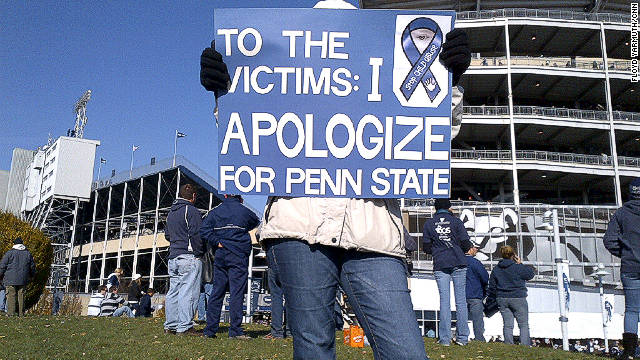
The nation is aghast at the Penn State sexual abuse/rape and subsequent cover up of the repeated assaults of young boys over a 15 year period. This case reminds us that even the most loved of places, those with the best of reputations, can have pathology coursing in its veins and leadership.

Jerry Sandusky a former coach is charged with sexual abuse of eight boys (and more victims stepping forward are expected). Tallying it all up currently includes 40 counts; 21 of them are felonies spanning 15 years of abuse having gained access to them through The Second Mile, a youth foundation he started ‘to help kids’. (Am sure the sexually abused children are saying ‘Gee thanks for that help.’)

Each of the 21 felonies carries 7-20 years and $15-25k fine with 19 misdemeanors carrying 2-5 years and $5-10k fine. Needless to say, the court rightfully so, finds the abuse allegations to be extensive. We can only guess how many rapes that accounts for over a 15 year span…and how many victims.

Mike McQueary, assistant foot ball coach witnessed at least one of the rapes in 2002 during which he watched, did not stop it, and did not immediately report it to law enforcement including campus police.

He did however pass the buck for reporting the rape by telling head coach Joe Paterno who also did not report to police, including campus police. A 23 page grand jury report said Paterno was told in 2002 about the sexual assault against an approximately aged 10 year old boy in the shower at the university. 

McQueary also passed the buck to Tim Curley, the athletic director and Gary Schultz the Senior Vice President (whose duties included the oversight of the university police) about the assault, none of whom also made the mandated child protective reports and reports to law enforcement.

Paterno’s defense to what he did not report was that McQueary was ‘distraught but didn’t tell me specific actions that occurred.’ There is no evidence that Paterno followed up to find what specific actions had occurred, or turned over the alleged ‘distraught’ concerns to child protective services or campus law enforcement.

All citizens are considered to be mandated reporters in child abuse cases and certainly university staffs are trained in reporting protocols for both the university and the state since they work with students. However, none of those protocols were followed and none of the mandatory reporting laws seemed to be applicable to them. You do not have to prove child abuse—you simply have to have a suspicion of abuse and then you are mandated to report. Child protection services and law enforcement will take it from there. 

A naked adult with a naked child is not a suspicion. That is a crime and a fact that is mandated, not only legally but ethically and morally.

Mike McQueary did not follow up checking with police or campus police to make sure Paterno, Curley or Schultz actually filed a report. While it is appropriate that he told others, it is not enough. The law is not ‘tell your boss and walk away’. It’s that you report. Whatever you do after that for ‘on the job’ notification to your superiors is separate and distinct from reporting. University staff is always trained in abuse protocols. It’s not that they didn’t know what they were supposed to do.

While being labeled as a ‘whistle blower’ about the university might be uncomfortable and a motivation for not reporting directly to law enforcement, it is not nearly as uncomfortable as being raped and scarred for life. It’s not nearly as uncomfortable as a child who knows you saw what happened to them in a shower and did not help them…in the moment or later.

Ramifications? Being labeled as a whistle blower, or being fired for covering it up—I mean ‘really?’ are we comparing those consequences with those of eight little boys whose lives were ruined from adults looking the other way. A job is equal to a rape in terms of ramifications? It was hid to save their jobs?

Let’s count here….

1.  Sandusky never confessed to what he had done to save himself from jail and keep a job.  Considering he’s a pedophile, not many were expecting him to have insight about how his behaviors were destroying someone else.

McQueary, a flicker of conscience…not in the middle of the rape, not even that evening as he went to bed…but the next day and a couple more notifications to others but not pushing the envelope enough to ask his superiors if they did something about his suspicions. Not wanting to incur the wrath of employers? Not wanting to seem outside of the good ol boy’s club that anything goes….job protection.

Curly never reported suspicions of abuse.

Schultz as a Senior Vice President and who oversaw campus police never reported suspicions of abuse. 


Who does that? Who places employment before anal penetration? Who places their football ego in front of oral rape? Who shows up year after year for work walking passed the showers where innocence was lost? Who oversees campus police and doesn’t make a report of suspicions? What kind of pathology does that? 

But instead, this moment of looking at not only individual pathology but corporate pathology is being lost. Instead of looking at the kinds of symptoms pathology perpetrates in the individual and in systems, we are instead hyper-empathically focused on micro issues: The ‘conflicted’ pedophile, the social psychology of why others look on and do nothing, the severe motivation of job loss at high levels, how well loved a coach is as evidence of guilt or innocence.

We miss seeing that when pathologicals are at the head guiding the system, they are making deep psychological imprints of their own pathological world views projected like a cult-reality on the screen of other’s psyches. That’s it not just an individual that can be sick, its entire systems that are guided by pathological and psychopathic belief systems. (Anyone ever read Snakes in Suits by the world’s leading expert in white collar psychopathic behavior, Dr. Robert Hare?) 

It took a system, not just an individual, to cover up 15 years of rape. It took the camaraderie of people who collectively had reduced empathy and conscience to hide the fact that little boys were penetrated, and kids were trafficked to psychopathic benefactors. Now there are allegations that the rape and assault of little boys were used as perks to pedophile benefactors.  It’s called human trafficking.

This did not happen in a vacuum as most trafficking, extended abuse, and cover up normally doesn’t. It takes individual and corporate pathology to create an environment of longevity and invisibility to perpetrate 15 years of rape. It takes pathology on many levels from being the pedophile to being a silent accessory to the crime to allow over a decade of soul destroying abuse in a psychopathic fraternity of football narcissism.

Systemic pathology has been seen through the years in the church, in the military, in the white house, in the FBI---in any large system. How did thousands come to believe that the holocaust was the right thing to do? It happened when one pathological in a system created a systemic belief system and brought into that system at high management levels other persons whose own pathology shared the basic core belief systems and those beliefs found their home and their spark with the pathological leader.

Think all of the players are not likely pathological? Want to split hairs about which Cluster B diagnosis they are likely to fall into and our inability to really diagnosis someone if they aren’t in front of us? I don’t. You can see from this case what happens when someone does not have enough empathy, enough insight into how their behavior affects others, enough guilt, enough conscience, or enough remorse. Whether the perps and accessories are cleanly in the ranges of secure diagnosis really doesn’t matter because even reduced amounts of these traits-of-humanity have caused pathological results in the lives of children. Here is an example when a Cluster B is really a Cluster F for everyone in their paths.

Pathology In Systems

The Psychopathic Checklist helps us view elements of pathology that can perhaps help us to expand the view to see pathology active not in just a person but in a system. I have check marked those that I think we can apply to the pathological belief system of the department/portions of departments that were involved. (Below is the Psychopathy Checklist- Revised created by Dr. Robert Hare). 

 Glibness/superficial charm (at least applicable to the charm and support and near-riots of the followers of Paterno).


Grandiose sense of self-worth (entitled to not follow the mandated reporting laws of child abuse)


Cunning/manipulative (the years this has continued is a tribute to cunning ability to hide it and/or manipulate others into not telling)


Lack of remorse or guilt
  • Shallow affect (genuine emotion is short-lived and egocentric) (unable to determine)
Callousness; lack of empathy


Failure to accept responsibility for own actions
  • Need for stimulation/proneness to boredom (unable to determine) 
  • Parasitic lifestyle (perhaps within a systems model type of approach)

Poor behavioral control


Lack of realistic long-term goals (lack of realistic long term outcomes of suppressing child abuse)
  • Impulsivity
Irresponsibility
  • Juvenile delinquency
  • Early behavior problems
  • Revocation of conditional release
Promiscuous sexual behavior
  • Many short-term marital relationships
Criminal versatility (lots of versatility displayed)


Acquired behavioral sociopathy/sociological conditioning (Item 21: a newly identified trait i.e. a person relying on sociological strategies and tricks to deceive) (developed within the context of a pathological system and leader).


Out of 21 items, 13 items if applied to the pathological system can be viewed checked off in the above list. That’s 65%.

Perpetration of Pathology By Non-Recognition

Hoping that the mental health system is going to jump in here and help with public pathology education? The perpetration of pathology invisibility is highly related to the lack of pathology education even within the mental health field. The inability to spot pathology in others, and certainly as we can see, the inability to spot it in systems, has kept the mental health field largely another system unable to identify it.

To the mental health field’s defense, Robert Hare (world’s psychopathy expert) calls these disorders the ‘disorders of social hiding.’ That is, they look normal in the context of their setting (especially when sprinkled in with more pathology that camouflages glaring overtness in any single one person). The more successful, wealthy, or well-liked one is, the less likely they are to be noticed as pathological. Mix it with the hyper-empathy and positive psychology approach of some clinicians and you have all the Kum-By-Yah’ness behind which pathology never gets pointed out and none of the forensic attunement that might help others learn from these examples of pathology.

My case in point, having started a discussion on several professional therapist forums, these are the responses that clue us in to whether the mental health field will lead us in the much needed public pathology education awareness field….

My posting was “Calling everyone who understand pathology: Do not let the Penn State teaching moment be lost in translation in words that do not teach pathology in action. This is not merely 'abuse' -- this is pathology in both those who did it and those who hide it. Who Does That? Help other see the Cluster B disorders in action. Use the real language!

The responses were:

I take exception to the use of Penn State being a teachable moment. It’s is my alma mater…1 football coach does not define the entire institution.”

IMO the abuser is less guilty than those who covered up.”

Perhaps we should discuss why people who knew did not act appropriately. What about these crimes (rapes) shut them down morally. Is something like this too overwhelming for the average person to deal with, thus they shut down?

As professionals we owe our clients to explore their case in all it's uniqueness and individuality….Why does this client have the craving for this abnormal sexual fondness of children?... we remain a blank screen on which the client can write the story of his life. As a professional I can see myself having empathy even with a pedophile… as for myself I am extremely disgusted with the persecutor and his helpers. “

The DSM can diagnose and predict and structure, but can not understand an individual's core conflict. This work can only be done one session at a time with compassion and lots if patience with our support as a holding environment.”

I agree that this is definitely a teachable moment for our students. If we talk about a possible diagnosis with the goal of building compassion, then I can get on board with that.”

In those statements is very little pathological identification (outside of pedophilia) especially in the accessories to the crime. While many of those accessories who turned a blind eye to the rapes are likely to be legally and criminally considered accessories to the crime, few of us are holding them to the same standard. We are interested in understanding them, not insulting an institution because someone attended there and seems to think this is a case about one coach and not all the other accessories—we are more interested in extending patience, support, compassion for the child rapist and accessories.  

I don’t see much interest in the world at large for exposing pathology for what it is so others can identify it in the future. If we don’t learn from what we have experienced, how do we bring that experience to light? I see little help in understanding pathology in corporate constructs or bilateral distribution of the crime of not reporting. Instead, the public outcry as witnessed on campus is a snapshot of the social investment to a perception—that there was one pedophile and that’s the end of the story.

From whom shall we look to understand personal and corporate pathology? Where shall our public pathology education come from?

Sandra L. Brown, M.A. is the CEO and Founder of The Institute for Relational Harm Reduction and Public Pathology Education.  www.saferelationshipsmagazine.com


Tuesday, October 25, 2011

Remembering Our Roots:Joyce's Brown's Influence on The Pathological Love Relationship Recovery Process


By Sandra L. Brown, M.A.


This weekend marked the 4th death anniversary of an extraordinary visionary. Many of The Institute for Relational Harm Reduction's highly acclaimed purposes, products, and processes came from what Joyce lived through, talked about, and role modeled for others.


Joyce, like other leaders, did not set out to do anything extraordinary. She simply set out to heal after two back-to-back pathological relationships. First a 25 year relationship with a narcissist and then an upgrade to a sociopath for 10 years left Joyce in the typical emotional fetal position that is common of the aftermath of pathological relationships.


She went through the normal stages of pathology recovery asking,


"What just happened?"


"Did I do that?'


"What's wrong with him?"


"Why am I so obsessed with this?"


"What's wrong with me? Why am I attracted to men like that and what does it say about my life that I would end up in a relationship like that?"


Without the benefit of mental health therapy and with only the support of a few close friends (who were quickly becoming weary of the ongoing saga of 'why' her, why him, why he moved on quickly, and why he picked the new woman), Joyce managed to piece together not only a recovery, but some profound insights that changed the quality of her life forever.


By then, at age 60, it would have been easy to say she would not likely find love, or heal. It would have been even easier to get bitter, get revenge, get hyper focused on him and his latest antics, or get in a fetal position and stay there.


But remarkably, Joyce rose from the dirt she had been ground down into. Like the symbol of the Rising Phoenix she not only rose, she dug out every particle of dirt that could be transformed from crusted pain and milled it for life changing insight.


She didn't keep these golden gems to herself--she talked to women about relationships wherever she was. Some of her approaches have trickled down to help other therapists work with women leaving pathological relationships.


Joyce believed women tended to drift sideways into pathological relationships looking for fun and excitement which actually pointed at what that woman needed in her life that would prevent her from taking just any old relationship.


"If you aren't living a big enough life that is as big as your heart, or as big as your personality, or as big as your dreams, then any old psychopath will do."


She poignantly asked herself "What is or is not going on in my own life that I would end up with a sociopath? Sure I didn't know he was one, he said all the right things...but what could this possibly be pointing out to me about me, the condition of my own life, and what needs to happen so I don't choose like this again?"


16 years later she had answered her own question:


In her 60's she went to college for the first time, became a short term missionary, she started her life in the arts of painting, sculpting, and pottery, she moved to a one room beach house so she could 'make up for lost time and play hard,' drove a convertible Miata to feel the rush of adrenaline she no longer had because the sociopath was gone. In her 70's she took up belly dancing to prove to herself she was still attractive, went to Paris to see handsome men so she knew she could still flirt, and got a motorcycle so she always had something hot to ride (!)--hey, I'm just quoting Joyce here. She became a hospital Chaplin to comfort the sick and fed the poor every week to give some of that hyper empathy away least it go to another psychopath. She sailed a Catamaran to the Bahamas to challenge her fear because she could not swim.


"A relationship is the icing on the cake. It is NOT the cake. Don't confuse the necessity of living life to be the icing. Living life IS the cake. Anything else, including relationships, is just the icing."


The Institute's own Jennifer Young who does phone coaching and our tele-support group had this to say about Joyce's impact on her and the women she helps, "Joyce Brown carries a big impact on my work with women. On her own she developed the innate ability to care for herself. That care translated into real solutions for disengagement from a pathological relationship. I believe the biggest, specific idea that has come from Joyce is the idea of 'Not One More Minute". I have shared this concept with many women who instantly feel the ability to disengage....not one more minute means I will not allow you to take one more minute of my energy, my love, my care, my compassion. It provides an end point...a point to say I'm done. This change in thinking, that I stop it, is crucial. It means that she has come to know and understand that he will not change, but I still can...and I will. So thanks to Joyce Brown for showing us the way to the end!"


At her death at age 76, she laid in a hospice bed only hours from death. I told her I wanted to toast her life. She said "Crank this bed up!" She fluffed her hair and with a glass of Jack Daniels in her hand, she said "I have had a great life. I lived, I learned how to have a great life, and I was loved. Who could ask for more?"


Her life lived well is what has impacted thousands of women worldwide and is the main thing women come away with who attended our retreats. Sadly, in this day and age, living a great life seems to be an extraordinary accomplishment. Her lecture on 'Get a Great Life' is what has spurred women on to not merely limp into recovery dragging their soul behind them. But to burst into recovery and fill their lives to the rim with all the things that her big personality needs in order to live fully. Lifeless living is what caused many women to seek the psychopath so full of energy that it seemed exciting and vibrant. Joyce said, "The problem is pointing to the solution. I loved the energy of those men! But what was that energy and why couldn't I have it another way? Was a psychopath the only way for me to feel life?"


Joyce learned that vibrancy comes from a life that is full of the things that interest, motivate, support, and challenge HER. If she wasn't living a big enough, interesting enough, motivational enough, supported enough, and challenged enough life....she would drift again into the arms of pathology to fill that space.


Feel how big YOU are and fill your own life with a great life!


From one of our readers, she wrote on Joyce's Facebook Memorial:


"Thank you, dear lady, for your continued inspiration - a legacy you've left to many you never knew but who have come to love you for your feistiness, tenacity, grit and that wonderful sense of humor!"


To celebrate Joyce Brown during her death anniversary and the month of DV Awareness Month, we are giving you our MP3 down load called 'Get a Great Life' inspired from Joyce's story for only $5! (Normally a $12 value).


To listen to a short clip of the audio, click HERE


TO PURCHASE, CLICK HERE


Get a great life and stop the cycle of pathology!


Sandra L. Brown, M.A. is the Founder and CEO of The Institute for Relational Harm Reduction and Public Pathology Education.  She is the author of several best selling books, including How to Spot a Dangerous Man and Why Women Love Psychopaths.

Thursday, March 3, 2011

PAS as a Religion


By Barry Goldstein


Perhaps we have been unfair to those who support Parental Alienation Syndrome (PAS). We keep citing research and information that discredits PAS, but they ignore scientific research and continue in their beliefs. And that is what we have missed. Their position is not based on facts or information, but because they are believers in PAS. What Gardner concocted has become a religion, sort of a PASology. If I remember correctly from Hebrew School, there is a letter that can sound like an "s" or like a "t." So more accurately their religion should be known as Pathology.

Perhaps PAS as a religion should have been understood earlier because the worshipers get so angry at any challenge to their beliefs and seem to find offensive any information that undermines the legitimacy of PAS. I came to realize the religious fervor of their beliefs after they published an article containing vicious personal attacks on many of the wonderful people, including professionals who spoke at the recent Battered Mothers Custody Conference. The professionals have chosen to accept a reduced income in order to continue to work on the side of abused women and their children. This contrasts with many court professionals like Gardner who realized they could make a substantial income by supporting abusers. Clearly the professionals at the Battered Mothers Custody Conference committed a serious sin by failing to worship at the altar of the almighty dollar.

I believe one reason it took so long to recognize the pathologists as a religion is that every other religion places a value on the truth. The adherents of PAS have taken a very different approach. We have seen them repeat the same lies over and over again so that over time it becomes their truth. Their God permits them to dismiss any inconvenient facts as if they never existed.

Included in the inconvenient facts is the current scientific research contained in DOMESTIC VIOLENCE, ABUSE and CHILD CUSTODY. This includes over 700 pages and thousands of citations demonstrating exactly what the pathologists disbelieve. Even more impressive than the quantify of the material is the quality. The book contains chapters from the leading experts in the U.S. and Canada including judges, lawyers, psychiatrists, psychologists, sociologists, journalists and domestic violence advocates. The research establishes not only that the courts are getting a high percentage of cases wrong and favoring abusive fathers, but their standard practices are flawed and inevitably lead to results that harm children and support abusers. Of course none of this information appears in the Pathologist's holy books.

PAS is used to support the worst of the worst abusers and its supporters appear unconcerned with the harm they do to children. For the true believer, undermining the belief in PAS is far more serious than hurting a child. For many of us, Holly Collins is a hero who risked her personal comfort and safety in order to rescue her children from unspeakable abuse. The court did not deny the father abused the children. Indeed it would be hard to deny it after the father beat his son so badly as to fracture his skull. Instead the judge said the mother's reluctance to encourage the relationship with the abusive father was more serious than the father's physical abuse. The evidence is so overwhelming that Holly Collins became the first American to receive asylum from another country. It should be embarrassing to this country that it was unwilling or unable to protect its own children so that another nation had to step in to protect these children. Nevertheless the pathological supporters of PAS continue to support the abusive father and even attack the children whom he abused. At least one prominent Pathologist encouraged supporters to stalk the family and said the brave mother should be gang raped. No wonder it has taken so long to understand these extremists as part of a religion.

Garland Waller, who was herself personally attacked by the pathologists wrote an important chapter in our book about the failure of the media to expose the scandal in the custody court system. One of the exceptions was a Newsweek article written by Sarah Childress that appeared in the September 25, 2006 issue entitled Fighting Over the Kids: Battered Spouses Take Aim at a Controversial Custody Strategy. The reporter used the Shockome case to illustrate the growing problem of courts taking children from safe, protective mothers and placing them with dangerous abusers because of the use of a sexist theory that has no scientific basis. Ms. Childress took months to research the story speaking to both parties and attorneys on Shockome as well as leading national experts and representatives of "fathers' rights" groups. She also reviewed thousands of pages of evidence so that she could determine the validity of what each side was saying. In other words she did exactly what a reporter is supposed to do and what many media outlets are unwilling to use their resources for. I believe it is significant that Ms. Childress looked at actual evidence which is missing from the decisions in Shockome and Goldstein and in the repeated attacks on Shockome by the Pathologists.

Interestingly, shortly after the decision in the retaliation case against me, Supreme Court Justice Sonia Sotomayor testified at her confirmation hearings. She said it is especially important for judges to describe and answer the arguments made by the side the court is ruling against. She certainly was not describing a new theory, but rather best practices for judges that has been the standard for hundreds if not thousands of years. Significantly, there is nothing in the trial judge's lengthy decision in Shockome or the Appellate Division decisions in Shockome or Goldstein that makes any attempt to discuss or answer the overwhelming evidence and legal arguments on the losing side. Accordingly, the Pathologists who claimed to have investigated the Shockome case claimed there is no evidence of the father's abuse. Unlike, Ms. Childress, they limited their investigation to what the abuser in Shockome told them and the court decisions that failed to respond to the evidence. So now after repeatedly claiming there is no evidence of abuse in Shockome, it is part of the sacred papers of Pathology and must be accepted by true believers of PAS.

One of the most important reasons custody courts keep making dangerous mistakes in domestic violence cases is that court professionals don't understand how to recognize domestic violence. Judge Mike Brigner in his chapter for our book gave several examples of normal behavior by battered women that courts routinely use to discredit allegations of domestic violence, but are not probative. This includes actions like returning to her abuser, failing to follow-up on a request for a protective order and not having police or medical reports. Of course if courts routinely discount allegations of abuse for reasons that are not probative, they will get a lot of cases wrong which is exactly what is happening.

Lois Schwaeber wrote an important chapter in the book about how to recognize domestic violence. Abusers engage in a variety of tactics designed to coerce, intimidate and control their partners. Most tactics are not physical or illegal, but too often inadequately trained court professionals look only for physical abuse. Genuine experts know to look for a pattern of controlling behaviors and to look for evidence of the alleged abuser's motivation. Most contested custody cases involve fathers who had little involvement with caring for the children during the relationship, but suddenly seek custody when his victim tries to leave him. They believe she had no right to leave and so they are entitled to use any tactic, including hurting the children in order to pressure her to return or punish her for leaving. Unqualified court professionals usually assume the father seeks custody out of love for the children and never look at evidence of his motivation. In most cases much of the evidence is subtle and you need to understand the motivation from context and comparison. For instance we often see a mother asking the court to limit the father's contact for safety reasons and the court treats this as if the mother is seeking to harm the relationship between the children and father and gives custody and control to the father. Once he has control he often unilaterally interferes with the mother's contact, asks the court to prevent contact and tells the children negative things about the mother, but the court does nothing to make sure the children have a relationship with their mother. The frustrating thing about the Shockome case was that the evidence of the father's abuse was very open and clear and could be seen by anyone who took a fair look. That is why the Newsweek reporter and various academics have used Shockome to illustrate the problem in the courts as the evidence is so easy to understand.

The evidence presented in the Shockome case is about as one-sided as possible. The protective mother presented eleven witnesses including five experts and neutral professionals including the school nurse, child's therapist and couple's counselor. The alleged abuser was the only witness for the father and the evaluator also testified. The evidence is even more one-sided than the number of witnesses as the father made numerous damaging admissions and the "neutral" evaluator testified she was influenced by her belief the judge and law guardian wanted the father to have custody. She also testified that she would violate her neutrality to find the father abused the mother as long as he continued to deny it. No wonder the abuser groups like her so much.


In his testimony, the alleged abuser admitted that he would call his victim as many as twenty times a day including as late as 1 AM when he knew the mother and children were sleeping. but THERE IS NO EVIDENCE OF THE FATHER'S ABUSE. PRAISE PAS.

During his testimony he also admitted saying that he brought the mother here from Russia so she has no right to leave. He also acknowledged telling her she will never get away from him. While this is the typical motivation of abusers going after custody we don't often hear them admit this. but THERE IS NO EVIDENCE OF THE FATHER'S ABUSE. PRAISE PAS.

Throughout the trial, the mother was accused of alienation because she told the children they should eat healthy foods, dress appropriately for the weather and avoid adult oriented programs. Now I understand this is what any good parent would tell their children, but it was considered alienation because the father did all these things although he denied them throughout the trial. Then during his rebuttal testimony when he learned there was a witness who observed his children, in as close to a Perry Mason type moment likely to be seen in real life, he admitted that he could not prevent the children from running around outside without their winter clothing. This was after they were observed running around a parking lot on the coldest day of the year without jackets. but THERE IS NO EVIDENCE OF THE FATHER'S ABUSE. PRAISE PAS.

In the context of the father's motivation for seeking custody, although he claimed greater involvement with the children than was accurate, he never challenged the fact that the mother provided most of the child care and is the primary attachment figure. He also did not dispute the evidence that he said he could not change his daughter's diaper because he might get excited. but THERE IS NO EVIDENCE OF THE FATHER'S ABUSE. PRAISE PAS.

Abusive fathers often seek custody as a tactic to gain access to his victim. This can be in order to seek to reestablish the relationship and/or to continue his harassment. The phone calls between the father and children was a contentious matter in which the father repeatedly sought to punish the mother by claiming she was preventing him from speaking with the children. The father submitted transcripts of his calls with the children. Revealingly, most of the conversation involved the father asking to speak with the mother or learning what the mother was doing. He certainly did not use the phone calls to bond with the children or work on their relationship. but THERE IS NO EVIDENCE OF THE FATHER'S ABUSE. PRAISE PAS.

During my cross-examination of the evaluator, she testified the father probably abused the mother physically, verbally and emotionally throughout the marriage. She testified the children probably witnessed his abuse. She testified the father probably caused the mother's PTSD. That sounds like pretty strong evidence of the father's abuse especially coming from a witness biased in favor of the father and who recommended the father for custody. Incredibly she said she couldn't base her findings or recommendations on these probable conclusions because she could not determine the extent of the father's abuse TO A CERTAINTY. The correct legal standard is preponderance of the evidence which roughly means probability which is the standard she used for the father's claims. For anyone wondering the basis for my statements that she used the certainty standard for the mother and probability for the father, it is contained in black and white in her report and when I questioned her about it repeatedly during cross-examination she repeatedly acknowledged using certainty against the mother and probability for the father and seemed not to understand what the problem was. but THERE IS NO EVIDENCE OF THE FATHER'S ABUSE. PRAISE PAS.

The same evaluator also testified the mother is a safe parent, was the primary parent and there was no alienation. Again it is hard to understand the rationale for taking the mother out of the children's lives and sending them to live with the probable abuser. but THERE IS NO EVIDENCE OF THE FATHER'S ABUSE. PRAISE PAS.

The child sexual abuse allegations described particular actions engaged in by the father with the children. The behaviors would best be described as boundary violations rather than molestation, but according to the expert witnesses making the children more vulnerable to future abuse. The father admitted to the acts alleged by the mother and described by the children. Two neutral experts, the child's therapist and the couple's counselor testified these actions constituted child sexual abuse. When the couple's counselor told the father the harm these behaviors were causing, he promised to stop. CPS and the evaluator decided that because there was no molestation the behavior did not constitute sexual abuse and the judge decided that even though the factual allegations were accurate and the neutral professionals had advised the mother the behavior was harmful to the children and constituted sexual abuse, she must have made the allegations in order to harm the father's relationship with the children. but THERE IS NO EVIDENCE OF THE FATHER'S ABUSE. PRAISE PAS.

I should note that the Pathologists claim the sexual abuse claim was bogus because the mother said she did the same thing to the children as the father was accused of. This is one of the ways we know that they never looked at the record, but relied on the biased judge's statement. In the decision he said the school nurse testified the mother did the same thing and relied strongly on this claim. In the actual transcript, however, the judge asked her if she remembered saying the mother did the same thing and she answered no. When we later obtained the transcript from the earlier testimony she never made the statement the judge claimed to have heard. I understand the transcript makes it look like the judge deliberately invented and used false evidence, but I believe he was so convinced that the mother was trying to interfere with the father's relationship that he honestly believed he heard the nurse agree even though the transcript shows she didn't. It is part of the bias against the mother he showed throughout the case.

The amazing thing about the actual evidence is that the Pathologists are claiming there was no evidence of the father's abuse and yet there actually was overwhelming evidence just in the testimony of witnesses hostile to the mother. The admissions by the abuser and the biased evaluator made the testimony of the mother's witnesses even stronger because it supported what they were saying.

One witness who testified at the earlier trial was a neighbor who was not a friend of either parent. She described an incident in which the father was banging on the mother's apartment door and yelling curses so loudly that the neighbor heard it all the way across the compound. This occurred on a day when the father was not scheduled to have visitation. but THERE IS NO EVIDENCE OF THE FATHER'S ABUSE. PRAISE PAS.

Another neighbor described how the father drove through the parking area of the mother's complex, near the children at a frightening rate of speed. Other neighbors spoke about how rarely they saw the father interact with the children when they visited or in public play areas and how he made the daughter wait out in the rain. A family friend described how the daughter would inappropriately undress in the apartment in front of others and the school nurse testified about sexualized behaviors the son engaged in at school. but THERE IS NO EVIDENCE OF THE FATHER'S ABUSE. PRAISE PAS. 

The mother provided compelling testimony of the father's physical and other abuse. She described how he refused to provide basic necessities when they were living in Texas before she received her degree and could earn a living. She described his abuse while she was pregnant and refusal to help with the children. She testified he threatened to ruin her financially and take away the children if she dared to leave which was confirmed by his admissions and aggressive legal tactics. When she described her husband's sexual abuse of her, the pain and embarrassment she felt were unmistakable and could not possibly have been faked. She provided many other details of the father's abuse, but this was the one part of the evidence I could not support with a transcript because the court erased the tape of her testimony (the court said it was by mistake and provided a statement from a technician attempting to explain how it happened). Accordingly the appellate court attempted to review the case without a transcript of almost all of the mother's testimony. but THERE IS NO EVIDENCE OF THE FATHER'S ABUSE. PRAISE PAS.

The school nurse testified about the sexualized and aggressive behavior of the son after visiting the father. She testified that only the mother was active in working with the school. The children were dressed appropriately when coming from the mother's home, but not the father's. Significantly, the children deteriorated significantly after they lost their mother and were placed with the abusive father. While living with the mother, the daughter was described as skipping around school, holding hands with another girl, laughing and giggling, but after she lost her mother she would walk around the school alone, head down and deeply depressed. She often came to the nurse complaining of stomach aches or other similar ailments. but THERE IS NO EVIDENCE OF THE FATHER'S ABUSE. PRAISE PAS.

The mother called five expert witnesses including the couple's counselor and the child's therapist who were neutral professionals. Both experts found that the father's actions violated the children's boundaries and constituted sexual abuse. The child's therapist said the father tried to silence the son and undermine his therapy. She also mentioned calls from him that were threatening and intimidating. This was confirmed when the father submitted tapes of the calls. The couple's counselor, whose job was to work with both parents told the father his actions constituted sexual abuse and was causing harm to the children. He promised to stop these harmful behaviors, but nevertheless sought to use the mother's concerns as if they were motivated to harm his relationship with the children instead of protect the children. but THERE IS NO EVIDENCE OF THE FATHER'S ABUSE. PRAISE PAS.

The mother's therapist testified that she and the mother's doctor had diagnosed the mother as having PTSD, the kind caused by a long history of traumatic events. Significantly, there was nothing else in the mother's life other than the father's abuse that could have caused the mother's PTSD. Another expert witness was Dr. Mo Therese Hannah who is one of the leading national experts on domestic violence and custody who confirmed there was nothing else in the mother's history that could have caused her PTSD. but THERE IS NO EVIDENCE OF THE FATHER'S ABUSE. PRAISE PAS.

When I wrote my appeal brief, I submitted the transcript date and page for every one of these facts that supported our points. The law guardian who is a PAS supporter, the father's attorney and the judges all had a chance to respond. No one challenged the facts I have just laid out because they were completely documented. Similarly in the retaliation against me, the grievance committee had my brief and all the citations. If any of my factual claims could have been challenged surely they would have done so. The evidence supported everything I said so they responded by ignoring the inconvenient information. It was not that there was no evidence, but those in power were making their determinations despite the evidence.

Clearly the pathologists rely on irrational beliefs and constant repetition of lies as their claims are dispelled when confronted with the actual evidence. This is not surprising as PAS is based on the assumption that virtually all allegations of abuse made by women are false when the actual research demonstrates false allegations are extremely rare, being false only one or two percent of the time. The new Department of Justice study led by Dr. Daniel Saunders says that unqualified evaluators and other court professionals who believe the myth that women frequently make false allegations are responsible for recommendations that work poorly for children. In other words, those who support PAS will be wrong about 98% of the time which is pretty much what we have seen from the pathological statements and personal attacks by supporters of pathology.

Now we have had a lot of fun laughing at the absurdity of the pathologist's attacks. I took a college course in the philosophy of religion. I remember they said that religions tell stories and use rituals as a means to help its members act morally and as long as the religion encourages moral behavior it is good for humanity. Although PAS is based solely on beliefs and not facts it cannot really be considered a religion because it encourages its members to act in the most immoral manner and hurt battered women, children and so many others. In reality the pathologists are a small group of abusive men with a strong sense of entitlement, together with those they can manipulate and professionals who seek to profit from the unspeakable torture of children.

They take advantage of the rare exceptions when women make false allegations or children have a bad relationship with their father because of what the mother said or did. Children tend to love their parents even when they are seriously flawed. Most times if a parent bad mouths the other parent in ways that are false the result will be to undermine the relationship with the parent making the false charges. More commonly children dislike a parent because of child abuse, neglect or domestic violence. Relationships are often strained for normal child development reasons as anyone with a teen would know. It is easy for an abusive parent like Alec Baldwin to blame others for the results of his abusive behavior. It takes honesty and maturity for someone to accept responsibility for the harm they have caused. Obviously it is far easier to blame others and concoct a magic theory to support their lack of responsibility.

Mental health professionals who have sought to profit from PAS are instead starting to lose their licenses because they are in affect diagnosing something that does not exist and is not part of the DSM. I hope professional associations will work to improve their reputations by disciplining unqualified members who profit by using unscientific theories. The last thing these professions need are members who are pathological.


Barry Goldstein is a nationally recognized domestic violence expert, speaker, writer and consultant. He is the co-editor with Mo Therese Hannah of DOMESTIC VIOLENCE, ABUSE and CHILD CUSTODY. Barry can be reached by email at their web site www.Domesticviolenceabuseandchildcustody.com


Tuesday, October 5, 2010

Emotional Phantom Limb Pain


By Sandra L. Brown, M.A.

In a session someone says "I really miss what we had. I could get over this if it hadn't been in the most wonderful relationship of my life. I just feel like something has been cut out of me. Like I'm missing a big part of myself now."

Pathology is marked by the issue of illusion. It's why our logo is a mask because it best represents the mirage of normalcy that pathologicals can often project, at least for a while. Cleckley from the 1940’s was a writer about pathology  and referred to it as "The Mask of Sanity." He states that pathology gives all the surface signals of deep connection, the most fun ever experienced with someone else, someone who is really into you yet behind the curtain you are being used as a distraction, a pay check, grotesquely as a "vaginal doormat" or some other form of "feeding" for the pathological piranha.

What you are experiencing you are internally labeling as "normal" or "wonderful" or "love" and yet it really isn't any of those things. It's just a label of experience you have tagged him with. If someone else was watching your relationship as a movie and watched the scene in which the pathological is exposed for what he is, your scene would be tagged and labeled by the watcher very differently than how you thought of your own experience.

That's because the watchers would see the pathological's behaviors and words as manipulative and the watcher would undergo a distinctly different view of the storyline. Your labeling of your experience isn't always accurate. As I often say, "Your thinking is what got you into this pathological relationship. Don't always believe what you think."

Being invested in being correct is part of the human condition and is in part, the way our brains work. The more important the question such as "Does he love me? Is this THE one?" The greater the pleasure will seem from labeling the experience as positive. The more positive the relationship is perceived, the more invested you will be to label the experiences and his behavior as positive and to get the reward of your label such as "him, marriage, or the relationship." Of course none of this is problematic except if you have misread the illusion, believed the mask, and labeled an experience with a narcissist, anti-social, or socio/psychopath as "positive."

The illusion is that:

* He was normal

* He was in love with you

* He was what he said he was

* And he did what he said he did.

In pathology, that's never the case.

* Their attachments are surface (which isn't love)
* They are mentally disordered (which is not normal)

* They never present themselves as disordered/sexually promiscuous/and incapable of love (so he wasn't what he said he was)

* And they harbor hidden lives filled with other sex partners, hook ups, criminality, or illegal/moral behavior (so they don't disclose what he's really up to).

What you had (that you can't possibly miss) is a pathological relationship.

What you miss, is the ability to wrap yourself up like a blanket in the illusion-to go back to the time before you knew this was all illusion.

Women often say when they try to break up they have the feeling that something is cut out of them. They feel like they are missing a part of themselves. This sensation is similar to what is called "phantom limb pain" that is a medical mystery of sorts. When a person has an arm that is accidentally amputated, the portion of the brain that use to receive sensory messages about the existing arm goes through a series of changes that causes it to misread the brain message and creates the "ghostly" illusion that the arm is still there and in pain.

Even though the patient can see that the arm is gone and what they are experiencing is an illusion, they can't stop the distressing phantom limb sensations of wanting to believe the arm is still there, the arm is in pain, the arm is anything but gone.  The amputee must learn to cope differently by beginning with relabeling the experience they are having which is the pretense of the arm is a perceptual illusion.

So it is with those leaving the illusionary pathological love relationship. The emotional pain you experience is based on the illusion the pathological presented, a perceptual illusion that was mislabeled, experienced as positive and invested in. Keeping that positive illusion is initially important to you. Learning to adjust the cognitive dissonance which is the ping ponging between he was good/he was bad is the challenge in overcoming the ghostly emotional baggage of phantom relationship pain.
Related Posts Plugin for WordPress, Blogger...

Disclaimer

The opinions and information expressed in the individual posts do not necessarily reflect the opinions of each contributor of "Time's Up!" nor the opinion of the blog owner and administrator. The comments are the opinion and property of the individuals who leave them on the posts and do not express the opinion of the authors, contributors or the blog owner and administrator.