Showing posts with label Police. Show all posts

Tuesday, November 20, 2012

PERF's Use of Excessive Force Report


By Heidi Hiatt


Last month the Police Executive Research Forum published a report called An Integrated Approach to De-Escalation and Minimizing Use of Force. This is part of its Critical Issues in Policing Series. Thank you to the B&G Report for bringing it to my attention.

This report featured a number of comments from leaders in the law enforcement and mental health communities about how to properly respond to incidents involving people who are mentally ill, developmentally disabled, substance abusers, or have medical problems. If you follow sites that track such incidents like Injustice Everywhere, you will see why there is concern nationwide over how law enforcement officers use force.

Less lethal tools are not always non-lethal. Officers may be trained how to handle calls physically but not mentally. They can go through extensive training on how to go up the use of force continuum but not how to come back down. Being so focused on how to maintain control of a suspect or situation physically, relying on muscle, may mean that officers are inadvertently increasing the dangers to themselves and others by heightening any aggression involved.

While reading these administrators’ comments, I thought about the myths that the public sometimes believes about use of force. Reality is, there are times when nothing else is appropriate but force because lives are in danger. There is no such thing as shooting the gun out of a suspect’s hand or severing a certain tendon in their knee a la Holly Hunter. Someone coming at you with a knife can usually get to you faster than you can draw your weapon– on the list goes. Policing is dangerous and officers definitely need to know how to defend themselves and others.

There is such a thing as overuse of force and it is a problem. I’ve blogged about Christopher Harris, a Seattle-area man whose head was slammed into a concrete wall during a flying tackle from a King County Sheriff’s deputy. You can often find a history of such behavior in the files of cops who do these things and this overkill can become a huge embarrassment to– and liability for– their department.

Several comments in this paper touched on some broader policing issues I’ve either studied or pondered. These have a lot to do with the appropriate use of force, but also with how to run a successful and respectful law enforcement agency.

Indianapolis Deputy Chief Lloyd Crowe said, “And, as with any situation, it is essential for us to have to have the right officer with the right mindset going into these situations. So I think the importance of hiring and selection should not be understated.” Well said. At some agencies there are stereotypes about what an ideal cop is and other agencies hire people who should not be cops.

Is the ideal cop an immaculately dressed applicant with all the right answers? Is it the muscular athlete with the military background? Is it someone with swagger or someone with a quieter approach to interpersonal communications? Is it the academic who majored in an unrelated field or the cookie cutter third generation applicant who’s been part of the lingo and culture their whole life? We need to consider that there is value in diversity.

For many years I’ve had concerns about how troubled and dishonest people cruise through background checks to land law enforcement jobs. Some of these know how to look and act like a department’s preconceived notion of what an employee should be, sociopaths included. Some people know how to flatter, flaunt their personal connections, use sex to get what they want, and practice other shady ways of entering the policing profession. These are often people who use the same tools to gain promotions and wind up in charge of others.

Police departments often run background checks on applicants and do detailed investigations of their personal histories. Thinking back on the psychological evaluation I went through years ago to take a civilian law enforcement job, I can’t believe that the battery of tests administered would actually filter out narcissists and sociopaths. The psychologist in charge was good and our conversation was my first introduction to deviancy among police personalities. But the tools used now seem so pliable including the overrated but venerated polygraph test.

This quote comes from Albuquerque Chief Ray Schultz: “We’ve had a lot of success with hiring civilians, who are all master’s degree level or higher, to work in our Crisis Outreach And Support Team, called COAST. They help field officers to bridge the huge gap between people who are self-medicating or trying to deal with the problems themselves and long-term service providers.”

Yes! Law enforcement needs to utilize the strengths of well-trained civilians to provide maximum benefit to the public. Policing is sometimes seen as a “jock” profession in which only the jocks are allowed to solve crimes, not the “nerds” who work in the office or can’t perform the same physical feats. It can be the so-called nerds who have the best crime analysis skills, or who are best suited to work with victims, or who are most qualified to profile a suspect. Departments need to get away from the stereotypical image of what their strengths look like and start tapping into the civilian talent pool.

Cambridge Commissioner Robert Haas discussed what the report called an essential tool, tactical disengagement: “This goes back to… how easy it is to ramp things up, but much harder to bring them back down. We need to be thoughtful about how officers can de-escalate a situation to get it to a peaceful resolution.” He’s right. This would not only be a useful tool for officers in the workplace but at home.

Some officers perceive a threat and all their agencies train them to do at that moment is ratchet their response up, up, and up. Like a hiker facing a grizzly bear, they might decide to yell and try to appear bigger and scarier than the bear. Some experts, however, advise that hikers should appear non-threatening to bears to deescalate the situation. Trying to be aggressive with a grizzly bear is probably just going to make the bear angry which puts you and everyone around you in mortal peril.

Some officers– please note that the qualifier “some” is used a lot because I know some amazing cops who are excellent at what they do– can never seem to disconnect from the power and control mindset that is infused in them by police culture. Not being willing or able to resolve a conflict by means other than a show of force is how wars happen.

It’s been said that diplomacy is the art of letting someone else get your way and more officers should know how to be diplomatic. They should also have at least some cursory training on how to interact with the mentally ill and others who might pose a challenge. When their default body language and communication skills are abrasive, disrespectful, or aggressive regardless of the situation, they are making enemies, not friends. They could be creating a greater danger than the one that already exists.

Philadelphia Captain Fran Healy addressed this: “They have told us that the instinctive behaviors they encountered by police, such as boxing in or staring, have actually escalated situations, placing officers in incredible danger. We hear from these individuals how the ‘cop mode’ tactics have increased the pressure inside these individuals, causing them to feel like a volcano ready to explode. Nonetheless, the officers are often completely unaware that it is their actions that were creating the pressure or danger.”

Think about that for a moment. Say you’ve had some friends over, it’s getting late, and a neighbor comes up to the fence to ask you to quiet down because their kids are sleeping. If the neighbor starts in with, “Hey! )(**#$*&@!” in a commanding, irate tone of voice with clenched fists, you’re likely to tense up and respond in an irritated manner too.

This is human nature. It revs up the fight or flight response. Add mental illness or substance abuse to human nature and you can get a much more potent, unpredictable cocktail. When all pistons of someone’s brain aren’t firing correctly, you could be taunting a grizzly bear whose primary interest, instinctively, is self-preservation. If you respond rather than react, and use a civil tone when appropriate, you might be able to keep control of a situation better than any other way.

This is an interesting report. I never read the comments of police administrators without considering what officers out on the street might say but found a lot of truth in these insights. Ultimately departments need to invest in appropriate training for their officers and objectively document officers’ interactions. They need to involve outside experts and look to civilians to augment public safety functions. They should be very careful about who they hire and how they handle questionable employee actions.

Most of all, law enforcement agencies need to do what Sheriff Doug Gillespie of the Las Vegas Metropolitan Police Department said, be sure that their culture supports their policies: ”You can have the best policies in the world, but if your institutional culture doesn’t support them, they won’t work.” He’s spot on. A department that values respect, empathy, and professionalism, and that maintains an open mind about how to best serve the public, will have a better chance of surviving potential use of force incidents unscathed physically and legally.


If we desire respect for the law, we must first make the law respectable. -Louis D. Brandeis

 
Heidi Hiatt, MA is as a Forensic Psychologist.  You can read more of her posts at her personal blog, Truth, Justice, and All-American Allergen-Free Apple Pie Straight Talk in a Crooked World

Tuesday, May 8, 2012

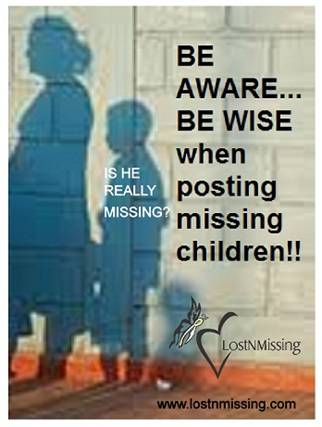
BE WISE!!!!! Is the child really missing?


 by Cynthia Caron

You could be liable if you are not wise to situations involving missing loved ones, especially children!!

While this may seem harsh...it is important to protect those whose photos are going around saying they are missing. We do not know if they are being stalked or legitimate missing loved ones?

Here are a few policies at LostNMissing Inc and most of those who are advocates for missing should adhere to the same when posting on social media sites :

1. We cannot post missing children without a registration at our org so that we can verify with police if it is a minor under the age of 18. Their immediate family/guardian (who have legal custody) must register them and will be asked to sign a form allowing us to distribute the photo of their minor child. THE ONLY EXCEPTIONS are posters from the National Center for Missing and Exploited Children....and media news alerts of missing children.

2. We cannot post missing adults...EVER...without a police contact phone number to verify they are missing and only will share posters that contain police phone numbers.

3. Missing Adults who have alerts in the media news can be posted.

If you have a friend, or a friend of a friend, who has a missing minor child under 18....please tell them to call 1-800-THE-LOST right away (NCMEC) and their local police department. Advise them if they are going to post their missing child's photo to use the name of the reporting police agency and the case number, otherwise...it could be viewed as someone just "stalking" someone or a non custodial parent , or otherwise, trying to find a child's location. THIS IS CRITICAL. Be wise. Protect our youth. ASK for this info before taking a "friend" on Facebook's word that their child is missing. We recently saw this happen not even two weeks ago in which the person looking for a child was NOT the legal guardian and portrayed as if the child was a runaway from their own home...when in fact upon police confirmation....that person did not have custody nor rights to that child and the child was with a parent in protective custody. BE WISE.

Respectfully,

Cynthia Caron
President/Founder
LostNMissing, Inc.


Friday, September 17, 2010

"Dead Wives Club"


By Susan Murphy-Milano


Earlier in the week the case of missing Utah mother Susan Powell, who has not been seen since December 7, 2009, made national headlines. The family was contacted by authorizes when remains were discovered in a Wyoming field that might be those of the missing Utah mother, the family as they have been since the day she vanished braced themselves hopes of finally being able to bring her home. But, it was not Susan Powell.In the world of intimate partner violence, the person responsible or those labeled as “person’s of interest” or “prime suspects” hope the person with whom they were in a relationship or married too, are never found. This speaks volumes as to the mindset of these killers. They look at the women, the mothers of their children as their property, similar to the assets acquired during the marriage.


The abuser is often enraged by the loss of power and control, not interested in what I term "sharing the dolls and dishes" accumulated during the marriage. So they formulate a plan and change the marriage certificate into a pending death certificate to be filled out and completed like a deadly bill of sale for discarded property. Before my mother was made a member of the "dead wives club" the rights to her own life, no different than those listed, were always owned and operated by my father.

After these pieces of cowardly human garbage wives and the mothers of their children is reported missing, the vanishing victims lives are weaved into brief by-lines in a community paper then the case stays alive because it is continued over to interactive forums and Internet sites like Websleuths, Scared Monkeys or Help Find The Missing. Human lives, that once move out from the 20 second headline blurb are kept warm with new developments posted until an arrest is made or it has been solved.

The wives and mothers, whose bodies have yet to be recovered, all vanished -- not under mysterious circumstances. The women simply wanted out of the abusive and often violent marriage. It's rare that most of these so-called missing persons cases includes any records of the abuse during the marriage. And in my opinion, once a report is made, each time enough information is gathered by authorities the crime reporting category under how it is checked off on the form box needs to be moved from "a missing persons" case to "intimate partner homicide investigation" case. For a victim of abuse, calling the police during a violent incident can and does set off the abuser and escalate the violence. If the victim has children, her motherly protection mode kicks in, and she backs down for the safety of the kids.

A victim of intimate partner violence makes an initial request, as they attempt to calmy reason with their potentially violent, controlling husbands to amicably end the marriage and move on is what happens to women such as:

Susan Powell -vanished December 7, 2009;
Stacy Peterson- Vanished October 28, 2007,


Kellisue Ackernecht- vanished September 30, 2008;


Sandra Travis-vanished July 31, 2005;


Tara Grinstead-Vanished October 22, 2005;
Rosa Lisowski-vanished September 5, 2008;
Bethanie Dougherty-vanished May 4, 2007;
Venus Stewart- vanished April 26, 2010;
Liza Murphy- vanished August 19, 2007;
Rachel Anderson- vanished April 16, 2010;
Lisa Stebic- vanished April 20, 2007 ;
Renee Pernice, vanished January 1, 2009;

Or those found dead, like Kathleen Savio in a dry bathtub; Monica Beresford-Redmond, beaten to death and left in a drainage sewer in Mexico; and Linda Yancey, whose police officer husband claimed she was a victim of a home invasion. They are only a handful of women who were forced into membership in the ever growing “Dead Wives Club.”

Thursday, January 7, 2010

Investigation 101: Tips For Law Enforcement and Family Members


By Tad DiBiase


I’m often asked by both the families of missing persons and law enforcement what the police and family should be doing once a person is missing but presumed dead. Here are five things the police should focus on early in an investigation and one thing the family can do. In any murder investigation, time is of the essence and the faster the police can gather clues, the greater their chance of finding the victim’s body and making an arrest. Note that all of these techniques are useful even if the victim is merely missing and not actually dead.  Moreover, although this are things done by the police, the victim's family can assist the police with these techniques by giving the police the ideas and the information that enables the police to investigate the matter.


1. Cell phones

Cell phones have a wealth of information and their widespread use in today’s society make them a valuable source of information. The police, often with the help of a subpoena issued by the prosecutor’s office, can get the records from the victim’s phone and see who the victim was calling, when the calls stopped and who called after the outgoing calls stopped. Checking the frequency of calls also help police determine who was close to the victim. Cell phones utilize cell towers to make calls and obtaining cell tower records tell police where a call was coming from. Indeed, the cell towers to which a phone sends a signal can change during the duration of a call, so police can track the path of the victim. However, phone companies keep cell tower records for very limited periods, often as few as 20 to 30 days so police must move quickly to get these records. Of course, all of these techniques apply to potential suspects as well.

2. Interviews

Police should immediately interview as many who know the victim as possible. Close family members and friends must be interviewed in detail to gather information. Videotaping these interviews is best because if the story changes down the road, the police have an accurate record of what was said initially. Any suspects should also be interviewed and their story thoroughly checked out.

3. Search warrants

I have seen over the years the difficulties police have in getting search warrants for suspect’s houses or other possible scenes in missing person’s cases. First, police should aggressively pursue consent searches if possible. If that fails, they must at least try to get a search warrant. There’s nothing wrong with putting in a search warrant that the police suspect foul play and that the victim’s characteristics are inconsistent with having simply left town, e.g., left behind children, is a child, have not accessed bank accounts, failed to show up to work, etc. Citing other cases of missing persons who were later found dead or were never found, increase the chances a judge will agree the victim may be dead. Getting inside a suspect’s house often leads to very valuable scientific evidence. Any search should include a cadaver dog. You’d be amazed at how often suspects bury a body nearby, sometimes temporarily until they can move it to another, safer location.


4. Pressure suspect

If there is an obvious suspect, pressure must be applied. Through effective interrogation techniques, a suspect will often confess early on since the guilt is fresh and the suspect’s story not quite thought out yet. A suspect should be placed under surveillance to see if he or she returns to the crime scene or where the body was disposed of. Advances in GPS technology have led police to placing GPS tracking devices on a suspect’s car and using the information to see where the suspect goes. For an interesting recent article from the Washington Post about this see, http://www.washingtonpost.com/wp-dyn/content/article/2008/08/12/AR2008081203275.html

5. Think creatively

Don’t treat the case like a missing person case, treat it like a homicide where the best evidence of the crime is missing: the body. Police must think outside the box. In one case, the family had not heard from the victim for sometime but was receiving letters allegedly written by the victim. The family, suspicious that the victim was actually dead, wrote back and reminded the victim to send the money he owed to another family member and to not forget that same family member’s birthday. A few days letter a birthday card arrived along with a check for $25. Of course, the victim did not owe that family member any money and it was not his birthday so the family knew that it was not the victim writing the letters. This is just one example of police and a family thinking creatively to ensnare a killer. Someone with the ability to conceal a body is not a criminal who is likely to make stupid mistakes like the bank robber who writes a stickup note on his own deposit slip. These cases are huge law enforcement challenges and require creative solutions and investigative techniques.

What can the family do?

First, never, ever give up.  No body cases are often solved many years after the fact.  Although forensic advances making solving these cases easier, many cold cases still exist and a family can never lose hope. 

Second, keep the pressure on the police and the DA.  don't be shy about calling to see what the status of the investigation is.  You're not being a pest, you're being  a squeaky wheel that needs oil! 

Third, try to keep the case in the media if possible.  Anniversaries of disappearances and landmarks for family members (victim's children's graduations, birthdays, etc.) are good hooks to get the media involved and interested.  Media coverage keeps pressure on the cops, suspects and witnesses alike, always a good thing. 

Fourth, consider, if you can afford it, hiring an investigator or attorney to conduct your own investigation.  Often third parties can get more information from police and prosecutors and look dispassionately at the case in a way you can't.

Thomas A. (Tad) DiBiase, No Body Guy
Reblog this post [with Zemanta]
Related Posts Plugin for WordPress, Blogger...

Disclaimer

The opinions and information expressed in the individual posts do not necessarily reflect the opinions of each contributor of "Time's Up!" nor the opinion of the blog owner and administrator. The comments are the opinion and property of the individuals who leave them on the posts and do not express the opinion of the authors, contributors or the blog owner and administrator.