Showing posts with label Psychological abuse. Show all posts

Monday, November 21, 2011

U. S. Department of Justice v. Custody Court System


By Barry Goldstein

Protective mothers have been complaining about mistreatment by the custody court system, but have routinely been dismissed as “disgruntled litigants.” As recently as the beginning of the Battered Mothers Custody Conferences in 2004, there was little professional support for protective mothers. The mothers’ complaints have now been confirmed and supported by the domestic violence community, many women’s organizations, numerous governmental agencies, many in the academic community and a substantial body of research such as contained in our book DOMESTIC VIOLENCE, ABUSE and CHILD CUSTODY.

Last summer at the NCADV Conference, Dr. Daniel Saunders of the University of Michigan and some of his colleagues presented their findings from a major Department of Justice study that confirms the findings in our book and other research that the present custody court practices for domestic violence cases are deeply flawed. The publication of these findings has taken longer than expected as Dr. Saunders and the Justice Department seek to carefully present the information in a clear and accurate manner, but they should soon be available on the Department of Justice web site. Many of us who seek to reform the broken custody court system are excited about this study because it should be difficult for the courts to dismiss or ignore because of where it comes from. Significantly, the findings are incompatible with a continued belief that the present practices are working for the benefit of the children the courts are supposed to protect.

Custody Courts Frequently Disbelieve Valid Abuse Complaints

Custody courts have a particularly poor record in responding to domestic violence cases. The research demonstrates that court professionals reject a high percentage of valid complaints by protective mothers. This problem has been confirmed in many ways. It is confirmed based on the frequency of mistaken outcomes. Although battered mothers make deliberately false allegations only one or two percent of the time, in contested custody cases the alleged abuser wins custody or joint custody over seventy percent of the time. Subsequent events regularly confirm courts’ mistakes. This occurs when men found safe by the court professionals are later convicted or otherwise found to have to have committed domestic violence, sexual abuse, murder or other similar crimes.

The revelations of the Courageous Kids Network further demonstrate the frequency in which courts fail to recognize valid complaints of abuse. Courageous Kids are young adults who have aged out of their custody orders and decided to speak out about the harm caused by these orders. The context is important in understanding their stories. These are cases in which the court disbelieved the mothers’ abuse allegations and gave the fathers complete control. The children have been threatened, coerced and punished if they continue to complain about their father’s abuse or seek a relationship with their mother. In other words the fathers have had tremendous assistance in silencing the children. Accordingly the children now speaking out represent a small minority of those mistreated by fathers the court believed were safe. The descriptions by the Courageous Kids demonstrate the fathers deliberately sought to hurt the mother and children based upon their belief system that the mother had no right to leave them. The children have had little or no contact with their mothers often for many years so we know the mothers could not be influencing the children’s decision to speak out about the fathers’ abuse. These are all too common examples of cases in which the court professionals failed to believe valid allegations of abuse.

The research not only demonstrates the fact that the custody courts get a large majority of domestic violence cases wrong, but also that the standard practices used by court professionals are deeply flawed and make it difficult for judges to recognize legitimate complaints about domestic violence and child abuse.

Court professionals routinely discredit allegations of abuse based upon factors that are not probative. At the same time these professionals do not understand the importance of looking to the abusers’ patterns of controlling and coercive behavior in order to recognize domestic violence. The court professionals often make the mistake of considering each incident and each allegation separately. Genuine domestic violence experts understand the importance of context in recognizing domestic violence, but the mental health and other professionals relied on by the courts do not understand the importance of context and thus make it more difficult to recognize valid allegations of abuse.

One of the big obstacles to recognizing valid abuse complaints is the common use of mental health and other professionals without expertise in domestic violence. The main purpose of considering domestic violence in custody cases is to protect the safety of children. Nevertheless the evaluators relied on by custody courts rarely know how to conduct a safety assessment or what behaviors have been associated with higher lethality and other dangers. The evaluators do not understand domestic violence dynamics and often are unfamiliar with the effects of domestic violence on children or other information based upon the specialized body of scientific research that could be used to better understand domestic violence issues and recognize truthful allegations of abuse.

The new Department of Justice study helps explain why the evaluators and other professionals relied on by custody courts routinely fails to recognize domestic violence. The study found that most evaluators and other professionals relied on by the courts do not have adequate domestic violence training and those with inadequate training are more likely to believe in the myth that women frequently make false allegations of abuse to gain an advantage in litigation. The professionals who believe this myth, in turn are more likely to make recommendations that harm children. In other words judges have little chance to protect the children under their control as long as they rely on these unqualified professionals and tend to believe their deeply flawed analysis.

Judges often become defensive when protective mothers or their attorneys request that any evaluator or other court professional be required to have domestic violence expertise in order to be appointed. We have repeatedly seen judges refuse to listen to domestic violence experts offered on behalf of protective mothers. The courts often focus on the need for a mental health degree even though the academic training for most mental health professionals included no or virtually no domestic violence instruction and the law does not require advance degrees to qualify as an expert (a common example is a mechanic without a high school degree who can testify as an expert in automotive repair based on experience and training).

In recent years most court systems have encouraged and usually required some domestic violence training for court professionals. This is a good thing but has often been implemented in ways that undermine the purpose. Many of the trainings include substantial misinformation such as the belief most contested custody cases are “high conflict” when the research establishes a large majority are really domestic violence cases. Some of the trainings even include Parental Alienation Syndrome (sometimes by another name because of its deserved notoriety) even though it was recently again rejected for inclusion in the DSM-V because there is no scientific basis for it. Many of the trainings fail to include domestic violence advocates or other genuine experts in domestic violence.

We have also seen some really good programs used to train court professionals, but I have heard many trainers complain that some of the judges, evaluators and lawyers pay little attention to the valuable information presented. In one Queens County, New York case I cross-examined an experienced evaluator who went to a really excellent domestic violence training in order to qualify as a parent coordinator. They provided numerous excellent research studies that could have helped him recognize domestic violence and protect children. During my cross-examination it became clear he never read the research and was unfamiliar with the current scientific research he needed to understand the case. When I pressed him about the training he described it as “not a life changing experience.” This was a man who needed a life changing experience because he failed to recognize the obvious history of abuse by the father, demanded the mother cooperate with her abuser and when she continued to try to protect herself and her son, the unqualified evaluator recommended custody for the abusive father. The judge failed to discredit the evaluator based on his failure to read or consider the current scientific research provided at the training.

We need much more and better trainings for court professionals, but there is also the danger that attending trainings can give judges and other professionals a false sense of confidence in their understanding of domestic violence. The findings by Dr. Saunders and his colleagues that most court professionals have inadequate training in domestic violence confirms our concern that in most cases the professionals relied on by the court are not qualified to participate in a domestic violence case without the assistance of a genuine expert. Even if the judge has received good training the court is likely to be influenced by unqualified evaluators and other court professionals.

The failure to possess adequate training in domestic violence means that it will be difficult for these professionals to recognize and respond effectively to domestic violence, but the widespread belief in the myth that women frequently make false allegations of abuse is a bias that strongly undermines the cases of protective mothers. These mistakes result in frequent findings denying the mother’s abuse allegations which is exactly what the other research has found. If a professional believes the myth they will expect to see false allegations and without training in how to recognize domestic violence they have little chance to get these cases right and protect the children. Even worse, courts having found against the mothers because of the deeply flawed practices and biases are severely punishing mothers and children because the mothers continue to believe their true allegations despite the disbelief of the unqualified court professionals.

A few months ago, in this forum, I wrote an article about the extreme decisions we often see in domestic violence cases. These are decisions in which the alleged abuser receives custody and the mother who was the primary attachment figure is limited to supervised or no visitation. The primary attachment figure is the parent who provided most of the child care during the first couple of years of the child’s life. When children are separated from their primary attachment figure they are significantly more likely to suffer depression, low self-esteem and to commit suicide when older. It can never be right to separate children from their primary attachment figure unless she is unsafe such as a drug addict, someone who beats the kids or otherwise poses a danger. In most of these cases the father allowed or even demanded the mother provide child care until she decided to leave him. It should be obvious that her decision to leave a man she found to be abusive does not make the mother unsafe. Unqualified court professionals frequently limit the mother’s contact with her children based upon some version of alienation or pathologizing the mother based on psychological tests that were not made for the populations seen in custody cases. We know the diagnosis is not safety related because the mother functions fine in all other aspects of her life except interacting with her abuser and the court professionals supporting him. These are not safety issues so these extreme decisions can never be beneficial to the children.

The reliance on court professionals with inadequate training and belief in the myth takes place in the context of many other common mistakes discussed in earlier research. The courts cannot protect mothers and children in domestic violence cases if they cannot recognize domestic violence when it is present. The frequent decisions that harm children are confirmed by later findings and information, the extensive research court professionals routinely fail to consider and the new Department of Justice study and they provide multiple confirmations of the present inability of custody courts to recognize domestic violence and child abuse when it exists.

Misuse of Mothers’ Anger and Emotion

Let’s look at this issue from the mother’s perspective and in the context of her experience. These are domestic violence cases. The father usually has a long history of controlling and coercive behaviors and the mother has finally gained the courage and resources to leave her abuser in order to protect her children. She is fearful because of the many threats he made of what he would do if she left and knowledge that the most dangerous time for a woman is after she has left. She is angry at the way he has mistreated her and often the children. She may be worried about her ability to support and protect her children because her partner has been telling her how useless she is throughout their relationship.

Even if the father’s physical abuse ends when he no longer has access to the mother (which makes unqualified court professionals believe he is now safe), he continues his domestic violence through litigation abuse and often other ways. The abusers often use any contact provided by the court to seek reconciliation and/or to harass and attack her verbally or psychologically. Many women expect the courts to protect her children because the evidence is so overwhelming and instead find the court pressuring her to cooperate with her abuser and punishing her if she tries to protect her children from a man they have found to be hostile and dangerous. In other words she has good reason to be angry and emotional and in fact this would be a normal reaction to her experiences.

The research contained in our book and elsewhere supports this understanding and analysis. We discussed the common mistake of custody courts that treat the mother’s actions as a litigant as if they were an indication of her behavior as a parent. Over forty states and many judicial districts have created court sponsored gender bias committees. These committees have found widespread bias particularly against women litigants. One of the common examples of gender bias was blaming women for the actions of their abusers. One of the typical examples of this bias is when courts blame mothers for their anger and emotion caused by the father’s mistreatment of them and their children. In many cases the abusers deliberately harass or pressure them shortly before a court appearance is scheduled in order to obtain an emotional reaction the court is likely to misunderstand. Abusers tend to be extremely manipulative and so after their abuse that the judge does not see, come to court calm and cooperative. Court professionals are often fooled by this act.

The new Department of Justice study confirms what we said in our book and other similar research. Dr. Saunders found that court professionals frequently treat mothers’ anger and emotion as far more important than it actually is in terms of the well being of children. These professionals may be uncomfortable with the mothers’ emotions particularly if she criticizes their response to the father’s abuse. Clearly these are difficult and unpleasant issues to confront. The misinformation treating contested custody as if it were “high conflict” when it is actually domestic violence contributes to the misunderstanding of the mothers’ anger and emotion. The professionals are focused on forcing the parties to cooperate even though this is not the best approach for children. When the parties have difficulty cooperating and certainly in domestic violence cases, parallel parenting is a more effective approach for children. The problem, as demonstrated by the Saunders’ study is that these professionals are focused on their beliefs and preferences rather than research about what works best for children. The custody courts did not get into the practice of looking to current scientific research and particularly the specialized body of research about domestic violence because there was no such research when the initial court practices were developed. We now have substantial research that would help inform court decisions and avoid the frequent mistakes but court professionals rarely look to this research to help them make better decisions. This is why we rarely see custody courts weigh the benefits and harms to children of a proposed resolution. The Department of Justice study establishes that these flawed practices lead to decisions that hurt children.

Cottage Industry Supporting Abusive Fathers

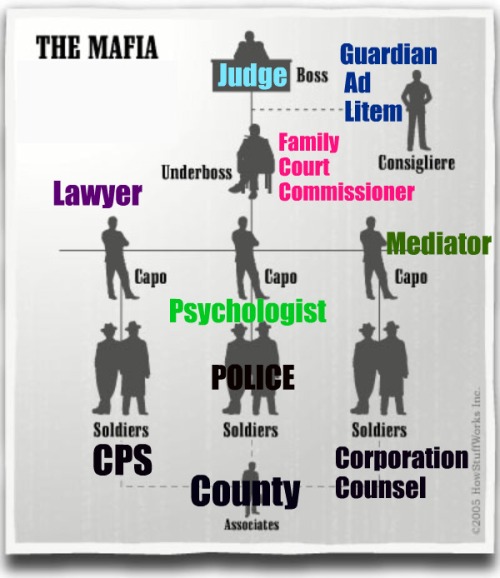
We often hear complaints about corruption in the custody court system. This belief is supported by the many cases in which courts make findings that are far removed from a fair evaluation of the evidence and decisions that seem to be disconnected from the well being of the children involved. There are cases of outright corruption such as the Garson case in Brooklyn, New York, but more often, I believe courts create the appearance of corruption because of bias, ignorance and deeply flawed practices. One of my concerns with complaints about corruption is that it makes it harder for judges in the broken system to hear the complaints and create the reforms that are needed. An important contributing factor to the widespread belief in corruption is the cottage industry that has been created to support abusive fathers.

Most contested custody cases involve abusive fathers seeking custody as a tactic to pressure their victims to return or punish them for leaving. Domestic violence is all about control so these abusive fathers usually have controlled the family finances and have these resources to support their custody litigation. Some lawyers and mental health professionals have figured out that they can make a large income by supporting practices and approaches that support abusers. We often see them advertise as supporting “fathers’ rights.” In many cases we see fathers’ attorneys and GALs promoting the appointment of evaluators who support abusive fathers. It is particularly frustrating when judges refer to these professionals who regularly support abusers as “neutral professionals.”

Protective mothers often have no chance when these biased professionals are appointed regardless of how strong their cases may be. Many of the mothers have complained that the evaluators and GALs make misrepresentations to the court in order to justify findings in favor of the abusive fathers paying their fees. When such professionals lie to the court about the evidence or to justify fees they did not earn, the mothers are justified in complaints suggesting corruption.

Many of these biased professionals strongly support PAS despite a lack of scientific justification. Significantly, PAS is based upon the assumption that virtually every complaint by mothers about the father’s abuse is deliberately false. The Department of Justice study found a problem with inadequately trained professionals who believe the myth that women frequently make deliberately false allegations of abuse. The unqualified professionals supporting PAS are even worse assuming that virtually all such allegations are false. The courts have virtually no chance of making the right decision if they treat such biased professionals as having any credibility.

The Department of Justice study’s contribution to this issue is a finding that evaluators working for the court or the county made recommendations that worked better for children than those of evaluators in private practice. When Dr. Saunders described this finding at a workshop during the NCADV Conference I asked him if he thought the findings supported our concerns about the cottage industry that has developed to support abusive fathers. He agreed this was a good interpretation. Evaluators working for the court or county are not paid extra for each evaluation so they have no incentive to favor the wealthier parent.

Professionals often have fundamental conflicts of interest. Medical doctors who schedule tests or procedures will earn money from performing the services they recommend. Tests may be scheduled to shield the doctor from potential lawsuits rather than to benefit the patient. Lawyers who recommend going to trial, starting a lawsuit or making a motion will earn money when the client takes their advice. Similarly, mental health professionals benefit financially when patients accept recommendations for more services. The conflict of interest is largely unavoidable and the professionals are expected to have the integrity to act in their client’s best interests instead of their own. Unfortunately some of the evaluators and lawyers, particularly those supporting abusive fathers have not fulfilled this ethical obligation.

We have repeatedly seen problems in custody courts with mental health professionals and particularly ones sympathetic to abusive fathers making recommendations requiring protective mothers to use their unwanted and unneeded services. We see these biased professionals pathologizing mothers who have always taken good care of their children with diagnoses that are clearly wrong. This would include the frequent finding of rare conditions such as Munchausen Syndrome by Proxy, conditions like paranoia or delusional based on the mothers’ continued belief in the father’s abuse despite the failure of the court professionals to recognize his abuse and other emotional problems that magically seem to affect only her relationship with her abuser and the court. They seem oblivious to the fact that that she does fine in other parts of her life that under any unbiased circumstances would rule out the claimed diagnosis.

Some of these mistakes are clearly deliberate and qualify as corruption. Other cases may involve bias and ignorance and a lack of the needed qualifications as the Saunders’ study demonstrates. When the professionals who are part of the cottage industry engage in gender bias they usually do so without realizing it. Many actually believe in the theories and practices they use despite a lack of scientific basis. Some of this can be explained by confirmation bias where the professional focuses on information or accusations that support what the professional expects to find and ignores information that undermines their theories and assumptions. We see this kind of mistake frequently in domestic violence custody cases and the mental health professional is often unconscious that they are engaging in confirmation bias. In fact they are likely to become defensive and angry at the suggestion. The Department of Justice study demonstrates the harm of using professionals who are part of the cottage industry and the need for custody courts to screen court professionals to avoid relying on them. Even worse, courts often use these unqualified professionals to train other court professionals. This can only serve to spread misinformation which makes it harder for court officials to recognize the problems demonstrated by the Saunders’ study and other current scientific research.

Conclusion

The custody court system tends to look at each case and each issue or event in a case separately. This is based on a belief that just because a man slapped his wife on Monday does not mean he punched her on Friday. The court system uses stare decisis which means once a case or an issue has been decided the same parties cannot relitigate it. There are good reasons for these practices, but they work poorly in domestic violence cases because of the importance of context in understanding domestic violence. We often see cases where the court denies allegations of domestic violence and they may even have been right if there was insufficient evidence. Naturally the abuser continues his abusive behavior so more evidence becomes available, but many courts refuse to hear the new evidence or refuse to consider it in the context of the previous evidence because those issues were previously litigated. In doing this the court is denying itself the ability to recognize the pattern of the father’s abuse and protect the children. Domestic violence experts are confident that the custody court system is broken because we see the pattern of mistakes and harmful decisions, but the powers in the court system are offended at the criticism and cannot believe the problem because they refuse to look at the patterns.

The findings of the Department of Justice study, by itself, provides convincing documentation that the custody court system is getting a large majority of domestic violence custody cases wrong. It would be impossible for courts to get most cases right when most of the court professionals have inadequate domestic violence training, those with inadequate training tend to believe the myth that women frequently make false allegations, the courts are placing too much weight on mothers’ anger and emotion and the evaluators who earn additional money through appointment in custody cases are making decisions more harmful to children then those who do not have a financial incentive. This study was not made in a vacuum, but was produced in the context of a substantial and growing body of scientific research that establishes the custody courts are making bad decisions in contested custody cases that endanger children. The research also establishes that the standard practices used in the custody courts are deeply flawed and outdated.

I am hopeful that a study coming from the U. S. Department of Justice will be harder for the custody court system to ignore. They have a strong reputation and can only be considered neutral. Furthermore, the courts frequently seek grants and other funding from the Department of Justice. Protective mothers and their attorneys can cite this research and it should be harder for the courts to ignore. I can’t wait until it is published on the DOJ web site.


Barry Goldstein is a nationally recognized domestic violence expert, speaker, writer and consultant. He is the co-editor with Mo Therese Hannah of DOMESTIC VIOLENCE, ABUSE and CHILD CUSTODY. Barry can be reached by email at their web site www.Domesticviolenceabuseandchildcustody.com

Wednesday, September 1, 2010

A Tearful Plea


By Gaetane Borders 


Granted it does not often happen, sometimes I am at a loss for words.  I was rendered speechless a few days ago when meeting with a student.  He was a handsome 10-year-old youngster who appeared shy and slightly awkward.  I met with him to complete an evaluation in order to determine if he has a learning disability. In his file I read that he has a history of behaving aggressively in school, and has been frequently suspended.

One task that I asked him to complete as part of my assessment was to finish a series of incomplete sentences.  One of the sentences was “I wish my parents…”  He completed the sentence with “were nicer.”  This is what sparked our conversation.  I asked him why he thought his parents were not nice, and he replied that his step-father calls him a “loser.” He rocked back and forth in his chair as he told me that his mother was aware of this, and frequently told him to “shut the f*#@k up.”  He also whispered that both of them tell him that he will not pass the 5th grade because he is “stupid.” He avoided my eye contact and instead stared at the ground as he shared his story.  Luckily for me because there was a pool of tears welling up in my eyes and I was clearly unable to keep my composure.  The thing that saddened me the most was that he recounted the instances of abuse nonchalantly…as if he felt that he deserved to be treated in that way.  Since his abuse was not physical, it could have easily gone undetected. Fortunately, he felt comfortable enough with me to share what was happening to him.  However, this is not the case for millions of children around the world because they suffer in silence.  

Bruises and broken bones are easy to spot, but you may never know that a child is told on a daily basis that they were a mistake or that they are ugly and fat. While physical abuse might be the most visible, other types of abuse, such as emotional abuse also leave devastating scars.  It severely damages a child’s emotional health and social development, and has profound psychological consequences. The following are examples of emotional child abuse:

  • Constant belittling, shaming, and humiliating a child
  • Calling names and making negative comparisons to others
  • Telling a child he or she is “no good," "worthless," "bad," or "a mistake."
  • Frequent yelling, threatening, or bullying.
  • Ignoring or rejecting a child as punishment, giving him/ her the “silent treatment.”
  • Limited physical contact with the child—no hugs, kisses, or other signs of affection.
  • Exposing the child to violence or the abuse of others, whether it is the abuse of a parent, a sibling, or even a pet.
Since abuse typically happens behind close doors, you may not ever witness any of these acts.  However, there are some warning signs that a child might be experiencing abuse.  Knowing the possible signs will enable an early intervention.  Here is a short list which demonstrates how some emotionally abused children may act:

Warning signs of emotional abuse in children

  • Excessively withdrawn, fearful, or anxious about doing something wrong.
  • Shows extremes in behavior (extremely compliant or extremely demanding; extremely passive or extremely aggressive).
  • Doesn’t seem to be attached to the parent or caregiver.
  • Acts either inappropriately adult (taking care of other children) or inappropriately infantile (rocking, thumb-sucking, tantruming).
Keep in mind that emotional abuse happens in all types of families, regardless of race or economic background. Experts say that some parents may emotionally and psychologically harm their children because of stress, poor parenting skills, social isolation, or lack of available resources. In addition, reports indicate that parents may be abusive because they, too, were abused as a child. 

After nearly 20 years of working as a School Psychologist, I continue to get emotional when I become aware of acts of abuse.  How anyone could harm a child in any way baffles me because there is simply no justification.  PLEASE, please…please learn the warning signs of emotional abuse.  Moreover, intervene by reporting the abuse to the officials.  Sometimes people are reluctant to do so because they are worried that the abusive parent will find out.  However, most states allow you to make an anonymous report.  Lastly, if a child tells you that they are being mistreated, reassure them that they did nothing to deserve the abuse…and believe them.

Sincerely,
Gaétane F. Borders, MA, ABD

To get help or report abuse, call the Childhelp National Child Abuse Hotline at 1-800-4-A-CHILD (1-800-422-4453).

Enhanced by Zemanta

Monday, August 23, 2010

Documentation of Abuse


By Heidi Hiatt

Typing furiously before he got home, I decided to make another copy. I cut the entire document, many months of notes, from the hard drive and pasted it on the disc whirring in its slot.

At that point I knew that a record of all of the threats, all of the frightening behavior, and my fears on what he was planning had to exist in multiple copies. I had to be sure that someone knew what really happened if I was unable to speak for myself.

Before ejecting the disc, I checked it to be sure the file was on there. Wait—this had to be a mistake. It wasn’t. I went back to the hard drive. I clicked paste again to see if pages upon pages of information would reappear.

It didn’t.

In my haste to get everything off of the computer before 7:00, I had erred and wiped out every bit of information that I’d been saving to get help. When the prosecutor became involved, they tried to recover the data from the disc, but it was long gone.

That incident made me more careful about saving important information that we may need later. It illustrated the importance of having multiple copies of such notes and the need to keep them in more than one place.

Today I want to emphasize how important it is to create and properly store documentation when something in your life doesn’t seem right.

There isn’t a criteria for what should and shouldn’t be saved. You don’t have to be able to prove something in a court of law to justify writing it down. You just have to trust your gut instinct that you need to be keeping a record of what’s going on.

There are many reasons to document what’s going on in your life. You may be experiencing emotional abuse, which frequently escalates. Maybe you are being falsely accused. Perhaps your partner is physically or sexually assaulting you, or things just aren’t adding up.

You may suspect that your partner is being unfaithful. Your spouse’s former partner may be stalking or harassing you. Your partner may be minimizing or excusing someone else’s behavior when it alarms you, or is making you feel like you’re the crazy one.

TRUST YOUR INSTINCTS.

If someone’s behavior is scaring you or making you uncomfortable, you don’t have to justify that anxiety to anyone. Something’s not right.

As security expert Gavin de Becker says in his must-read bestseller The Gift of Fear, “intuition is always right in at least two important ways; it is always in response to something. It always has your best interest at heart.” He also reminds readers that denial is a save now, pay later scheme.

If things don’t seem right in your life, just start writing. It’s that simple. It is important that you make a permanent record of the events that you sense as “off.”

Don’t be a perfectionist about it. Whether you jot down three sentences on a calendar about what happened on a given day, or you take twenty minutes every night to maintain a detailed diary, just let it flow. It’s unlikely that you’d feel motivated to do it if something wasn’t wrong.

I prefer a free-flowing journal format in which I state the facts and then add how I feel. It is important to record facts and who witnessed the same things. If you need a court order or you have to protect your children in a child custody case, the judge is going to be more keyed into material presented to them as facts than feelings.

It is also important to record your feelings. You might be surprised at how deeply you have been hurt, or how bothered you actually are, when you start letting it out. In this way journaling your circumstances not only protects you, it is therapeutic because it lets the poisons festering inside of you drain out.

Be specific in your entries. Let it all out. Don’t write as if you’re going to be embarrassed about it later. Tell people there’s no way you’d commit suicide, so if that’s suspected, they should investigate until they find out the truth.

If someone’s deception led to rape or medical problems, if your partner was having an affair, and no matter what mistakes you might have made, be sure it’s all there. Honesty is the best policy.

If you won’t do this for your own sake, then do it for your kids, your significant other, or other people who may be hurt by the questionable behavior. Abuse and stalking never affect just one person. You are probably not the only victim of that stalker or abuser, and you may have the opportunity to stop them from doing it to others.

If you are being abused—whether it’s emotional, physical, or both—DO NOT let your partner know that you are keeping those records. There may be times where you want to pull the document out and read to them how you feel, but you have no guarantees that they will ever be sincere about changing their behavior.

If you are keeping tabs on a third party who is trying to harm your relationship or is causing you fear, your partner may be well aware that you are keeping records, but not agree on how to handle that person. Keep a copy hidden from them anyway. Some people’s loyalty shifts like sand dunes in a hurricane.

If you are the family member of someone who is being used, stalked, or making bad choices, you might want to keep your own journal. Your relative doesn’t need to know about it. It might be your “just in case” plan.

You might see your loved one engaged in a relationship that is sure to take them off a cliff at some point. You may notice that they seem oblivious to the consequences of their choices. Write it down. Your prudence could help save a life.

If the information you want to keep is digital, like a photo or information on the internet, and there’s no clear “save as” option, press your “alt” and “print screen” buttons at the same time, then paste it into a Word document. You can also print it.

Because electronic information can be easily replicated, I prefer to save things to CD, DVD, and/or an external hard drive. While it is wise to keep certain original documents, you can keep copies of receipts and medical records by scanning them into your computer. You can also make, save, and duplicate audio and video material.

If the person harming you has access to your computer, you should be very careful about this. They can track your internet usage, rifle through the recycle bin, or maybe even be tech savvy enough to recover files you’ve deleted. You may want to use a library, work, or friend’s computer instead.

For some good information on how to protect yourself, check out Susan Murphy Milano’s book Time’s Up: A Guide on How to Leave and Survive Abusive and Stalking Relationships, http://www.amazon.com/Times-Up-Abusive-Stalking-Relationships/dp/1608443604.

DO NOT STORE THESE DOCUMENTS AT HOME, OR SOLELY AT HOME. I cannot emphasize that enough. Do not keep records of such value in an obvious place. Ensure that if your home is broken into or destroyed, or if your computer is stolen, your tormentors won’t have access to your files. You always have to be three steps ahead of them.

Because a safety deposit box is an obvious choice, you may want to give or mail CDs to people who’ve proven their trust and loyalty for safekeeping. You could give them a small locked box that you ask them not to open in case you are incapacitated, missing, or deceased.

There’s also off-site electronic storage so that you can transmit and update such information over the web. But I advise keeping hard copies in places and with people that are not easily suspected anyway.

Maybe you have a relative 3000 miles away who could keep your files without looking at them, or you have not just people but hiding places that trusted friends will know about.

The bottom line is to be sure that trusted friends or family members, your attorney, and/or your executor know how to find this information if something happens. It is important that more than one person knows where to find your off-site records in case of emergency.

You can have this written into your will. My will is set up so that certain documentation will be automatically disseminated to multiple entities, government and otherwise, about several situations if I expire prematurely. An adequate attorney can help you put your instructions in concrete.

You must structure this life and the next in such a way that no one will get away with harming you or your family. So no matter what happens, the truth will come out, and what the perpetrators have dished out will come back on them a hundredfold.

Even if your abuser works in the legal system, that information doesn’t have to be released to the legal system only, or at all. You can arrange for the truth to be sent to people in the media, politicians, family members, acquaintances, or activists.

Chapter 4 in Susan Murphy Milano’s Time’s Up workbook details how to create an increasingly popular means of documenting abuse, an Evidentiary Will and Abuse Affidavit. As she says, this information isn’t supposed to scare you, but protect you.

An Evidentiary Will and Abuse Affidavit is a notarized document and video documenting the truth to be kept in a secure location. It is not a substitute for taking steps to protect yourself in the here and now, but an added layer of insurance.

Here is an example of the video portion of an Evidentiary Will and Abuse Affidavit: http://www.youtube.com/watch?v=a9uGnrtwK3Q

Documenting abusive, suspicious, or inappropriate behavior is advisable for men and women, the dating or married. Our society sometimes forgets that men can be victims of these trials and deceptions as well because women are abused more often than men.

Any violation of your personal boundaries is unacceptable no matter who you are. Please protect yourself—and those you love—by keeping detailed records, which helps you beat your abusers and accusers at their own sick game. You can—and should—come out on top.

**********************************************************************************

Stalking is a frequently misunderstood and belittled concept. I’d like to highlight a definition of stalking that I found for a term paper on the subject.

One of the most comprehensive definitions of stalking in modern academic literature is “a course of conduct directed at a specific person that involves repeated physical or visual proximity, nonconsensual communication, or verbal, written, or implied threats sufficient to cause fear in a reasonable person”

Stalking is not simply following someone home from work, or making repeated phone calls. It can be any repeated behavior that places someone else in fear or violates their boundaries.

**********************************************************************************

One of the greatest sorrows of human existence is that some people aren’t happy merely to be alive but find their happiness only in the misery of others.
–Dean Koontz


Enhanced by Zemanta

Friday, June 4, 2010

Officer-Involved Domestic Violence


By Heidi Hiatt
Last weekend in Gig Harbor, a Pierce County Sheriff’s deputy shot and killed his in-laws, held his own children hostage, and then committed suicide.
I was shocked; then I wasn’t.
The media didn’t name the victims right away and I wanted to know who they were. The murder-suicide happened right behind my old middle school. I grew up in that area.
Like the Brame murder-suicide in Gig Harbor in 2003, in which the Tacoma police chief shot and killed his wife and then himself, this hit way too close to home. In more ways than one.
I didn’t want to blog about this until the investigating agency released the motive. The motive seemed predictable, but that’s probably because I’ve experienced domestic violence by cop. More than once.
Today the Tacoma News Tribune said that Deputy Allen Myron killed his mother-in-law and father-in-law because he believed they had “turned his wife against him.” There it is. Power and control. Shifting the blame.
Myron shot his father-in-law in the driveway, dragged his body into the garage, and then hosed the driveway down before shooting his mother-in-law. She managed to escape from the house and get help before dying at the hospital.
Myron’s daughter and a family friend were told to go downstairs, but it sounds like they were aware of what was going on. News reports say the friend tried to talk sense into Myron, but after conversing with the police for awhile, he committed suicide.
Myron’s wife had just gone to his commander about his behavior the day before. As in nearly every other shooting spree or domestic violence homicide, there were possible red flags ahead of time to indicate that something was wrong. There may have been emotional abuse. Problems in the marriage. Depression. A long-term medical leave and persistent physical pain.
Yet it’s hard to believe, when you’re part of that family, or friends with the troubled person, that they are capable of homicidal rage. Inevitably, people will remember a “devoted family man” and a “nice guy”, and he may well have been that part of the time. But now we know there was another part of him as well, the part that felt like he was losing control.
I know this man’s family loved him, and I don’t want to judge things I don’t know. But I do know that power and control is almost always the basis of abuse, and it can be complicated by mental illness and addiction. Domestic abuse affects an estimated 40 percent of law enforcement and military families, a higher percentage than the rest of the population.

If this man felt that his in-laws or someone else were “robbing” him of control over himself or his family, then he may have felt that he had to punish them for it. It is important to remember that the risk of homicide goes up 75 percent when you leave an abusive relationship. Some people just can’t stand losing control—they don’t want you, but they want the final say.
Before I continue, I want to say that some of the best and worst people I’ve ever known work in law enforcement. There are a lot of cops who selflessly risk their lives all the time for the greater good. I am eternally grateful for the police department that stood by me when I had to stand up to death threats and abuse by my police officer spouse.
Some of my best friends work in law enforcement. I have family in law enforcement, and I’m a fourth generation civil servant. My family has law enforcement associations going back to the 14th century. I will be the first person on your case—like a bad rash—if you malign the good cops I know.
But there are psychologically ill and abusive people in the profession who take their problems out on their families. They project blame onto others, they can’t leave their authority and badge at work, they accuse everyone else of perpetuating problems that only they can control. My life has been profoundly affected by such people, as well as the actions of the police department I worked for that led to my being harassed out of my job and long-term unemployment.
So desperate was one supervisor to cover their actions that they committed perjury in an unemployment hearing. I never got unemployment benefits even in spite of a concurrent disability issue. I believe this person used my domestic violence situation to undermine my credibility so I wouldn’t be believed if I reported them for a suspected wrongdoing. Who would believe the “problem employee” who was already accused of lying about domestic violence to “get attention”?
I have been so deeply disturbed by the incidences of certain behavior patterns and mental issues I’ve seen in some law enforcement employees that I earned my criminal justice degree and am working on my master’s to address those issues. The current hiring and screening procedures that police departments use to weed out undesirables can be beaten by psychopaths and other cunning personalities.
On top of that, there is such a strong sense of brotherhood within law enforcement that some people will do just about anything to protect a coworker accused of a crime. Many police officers have such powerful bonds because they have to protect each other’s lives. They have to know that the next guy’s always got their back. That can become a problem when the next guy does something wrong.
Additionally, I feel very strongly that police employees and their families are not provided with appropriate crisis and stress management resources. So not only do some deviant people gravitate towards the profession, but decent people can be damaged by its macho, show-no-weakness culture once in it. Their families are frequently forgotten about when the employee needs treatment. Families would also benefit if each shift concluded with a debriefing similar to the briefing that starts officers’ days.
In the wake of the Brame murder-suicide in Tacoma in 2003, many police departments instituted domestic violence policies, supposedly to protect victims of police officer abusers. Networking with other survivors of cop domestic violence, as well as my interactions with lawmakers, has shown me that these policies are largely ineffective. The department I used to work for put such a policy in place a month after my abuser was arrested, but it did not apply to me because the perpetrator worked for a different department.
I have heard far worse stories than mine from women who’ve stood up to domestic abuse in law enforcement, but I can attest to the mismanagement of such cases by police departments too. When I joined the state’s Address Confidentiality Program, my supervisors tried to publish my actual home address in the department directory anyway. They illegally coerced me into giving them that address in a sealed envelope, which was always hanging over my head when I tried to fight back against mistreatment.
When I asked to park in the police department’s underground parking garage, my request was ignored. The county prosecutor’s office asked the chief’s office for me, and I got an email from my boss suggesting that I park at a new lot a quarter mile away—in the dark of winter. I already parked off-campus and because of working different hours than my coworkers, walked to and from my car alone. My then-spouse had threatened to kill me with his “sniper rifle” while I was in my car at work.
I was not allowed to tell my police officer coworkers that I had a protection order, anti-harassment order, and restraining order against my abuser, meaning that he might not have been questioned if he showed up at my workplace. When he “sold” his personal firearms to a lifelong friend and next door neighbor to spring them from safekeeping, I had to go over the police department’s head to get the mayor’s backing to tell my coworkers what was going on. That was for their protection as well as my own—and even then, the department wouldn’t do it. I wasn’t allowed to do it. The union did.
What my coworkers knew about my situation was tightly controlled, and while most of my coworkers seemed neutral about my situation, the harassment and bullying from certain people never stopped. One lieutenant allegedly told their squad to ignore the allegations against my ex because I was making them up for attention. The department did nothing. My supervisor later told me that “we didn’t want to be sued for libel and slander for telling people about the arrest and court orders”—even though the perpetrator had agreed to attend two years of alcoholism and batterer’s treatment to get the charges dropped.
In my exit interview, at a time when I had just lost a family member and needed a medical leave but decided to get out instead, I tried to report everything that had happened to me on the job– again. To date I had been told I was an extremist, that I was outspoken, that I was treating a supervisor poorly, asked if I were going to become a “man hater”, and reminded several times that no one wanted to get involved in a “personality conflict” between me and a supervisor.
There were different standards for me, and the rules surrounding my duties were subject to change. I was under intense scrutiny. I was talked to as if I were a troublemaker who was harassing others. I was treated like a liar, and routine requests for time off were treated as suspicious. Personal information was shared with people I didn’t tell. I was pushed out of certain projects and committees, and credit was unfairly taken for work I did.
My passion for helping crime victims was ridiculed as me promoting my own vendettas and personal agenda. There were two incidents in which I almost called 911 from my desk (which was answered in the same building). It was, by legal definition, a hostile work environment.
Returning to the above-mentioned exit interview, the HR director looked at me and said, in the presence of a witness, “We hope you never work in law enforcement again. It’s a poor fit for you and you don’t follow orders well.” Conveniently, the witness had the day off when I presented that statement as proof of what had happened in my unemployment benefits hearing.
I could continue on for pages about how I was treated for standing up to a cop abuser, and what it has cost. I could not go to training at other agencies without people gesturing at me and staring at me. When I got out of that job and applied for other law enforcement jobs, I soon wondered if I had been informally blacklisted despite the official background checks on me being clean.
There was no form of legal help at any level who was willing to take on a police department over this treatment. Government agencies wouldn’t help, attorneys wouldn’t listen without down payments, and many people told me to drop it and walk away. I tried to get help from the police chief and new mayor, and everyone else I could think of, but was largely ignored.
I was blessed to have a dynamic prosecution team and steadfast police department defending me during the criminal proceedings following my abuser’s arrest, but there was no such protection for my job and reputation. When I had another traumatic law enforcement-related experience years later, I realized that until something blatantly criminal happens, there’s nowhere to go. You have to defend yourself and seek appropriate resources to get yourself back together rather than depending on the system like a “normal” victim.
Those things now lie in my past, and I believe in a just God who has seen it all. He said vengeance is His, and He’s a lot bigger and scarier than me. Knowing He’s in control and that He is concerned with my accusers’ lives as much as He is with mine has allowed me to move on.
My immediate concern is for the wife of Allen Myron. Is she being believed? Will her concerns be downplayed or minimized in defense of a murderer because he was a cop? Will the fabled “blue curtain” close her off from information that will substantiate her concerns? Is mental health counseling and religious support, if applicable, being provided to her and their children? Or are they being told not to talk to anyone while the investigation is active?
Will Myron’s family get good support from his coworkers and the department? Did Myron’s coworkers or superiors see behaviors they should have reported? Was he provided with proper resources, like mental health counseling or psychological screening? Was this agency prepared for the psychological fallout that could happen after recently losing five associated officers, four in the same incident?
The Pierce County Sheriff’s Office has already been through hell the past six months and I can’t imagine what they’re going through now. I just hope and pray that the Myron family is being given everything that department can give while this crime is investigated, and that they are not forgotten when it all settles down. Let’s trust that law enforcement employees affected by this tragedy are provided with mandatory, ongoing psychological support.
I hope we learn that Pierce County acted swiftly and decisively at the first hint that something was amiss in this deputy’s life. That took amazing resolve for his wife to even approach the department for help. When you report a domestic abuser, you don’t know what they’re going to do to you or your children, or anyone else, when they find out they’re in the hot seat.
Authorities also need to realize that the first report of domestic violence is often an exploratory exercise in which a victim only mentions some of what’s going on, just enough to get their attention. Details that could affect the abuser’s job or family’s safety are frequently left out. The victim initially wants to know what help is available and will only reveal the whole story when they’re relatively sure that they can trust the police department they’re talking to.
By mentioning my own story as just one example of how police departments mismanage officer-involved domestic violence cases, I hope that policymakers and authorities will realize how important it to have procedures in place for times like these. Officer-involved domestic violence policies should not exclude certain people or allow victims to be harassed or bullied. These policies should provide swift, sure action to prevent tragedies like this as much as possible.
Pierce County may have done everything by the book. If they have, then they should be upheld as an example of how to deal with officer-involved domestic violence correctly. I’m not alleging any wrongdoing. It may turn out that Pierce County has no responsibility in this matter. There might not have been any warning signs on their end, although their spokesperson said something about there being a problem with this employee before. It should also be noted that he wasn’t on duty when this happened.
Was it preventable? Was Sara Myron treated properly when she came forward? For the record, I am NOT trying to create disruptive conspiracy theories. These are the questions that have to be asked every time an officer-involved domestic violence incident happens. We need to learn what we can from these crimes and do our utmost to keep them from happening again.
I really believe that if law enforcement families are provided with proper psychological support and resources, and domestic violence victims in those families know they will be taken seriously when they come forward, we could significantly reduce the incidence of domestic violence among cops. Whatever happened in this case, let’s be honest about it and improve upon it.
I guarantee that when this story first went public, there were scores of police officer wives sitting at home praying, “oh dear God, please don’t let this happen to our family.” And if any of those women had decided to seek help from law enforcement, at least a few of them would be guaranteed to be permanently branded as liars, attention whores, deceivers, martyrs, sympathy-seekers, and any other derogatory term that excuses their abuser’s cowardly violence. They would be considered lepers and driven to the fringes of cop society.
Do you want to lose your friends? Wind up fighting for custody of your kids? Lose your house? Decimate your life savings and any other financial resources? Relocate to an entirely different area? Have potential partners run away when they find out your “past”? Live in isolation? Miss out on future job opportunities? Have to avoid certain places, even certain cities? Put your life goals and dreams on hold?
How about having to arrange your legal affairs so that every last detail of your situation is automatically disseminated to multiple entities if something happens to you? And having to prepare yourself mentally to have absolutely no hesitation to kill someone in self-defense should you ever be forced to defend yourself or your family? You can achieve all of this and more by standing up to domestic violence in law enforcement.
It shouldn’t be like this. It’s not fair that some victims are taken seriously and others are automatically derided. Every officer-involved domestic violence incident should be reviewed by a higher authority than the police department where the suspect and/or victim work. Having another agency investigate allegations isn’t good enough. Incidents need to be reviewed outside of police culture to avoid any negative influences.
There should be a state-level panel made up of both public and private sector representatives that will review the department’s actions and ensure fair treatment of the victims. Panel members should include domestic violence advocates from nonprofit organizations. A department’s actions should be fully transparent and they should be held accountable if the domestic violence survivors in question are treated any differently than “regular” survivors.
In conclusion, and I know I’ve been jumping around, my thoughts and sympathies go out to the Myron family. What mixed emotions and horrors you must all be dealing with as you process the loss of three family members. I hope that you are treated with respect, with dignity, with honor, and with love. You deserve no less from a system sworn to protect you and serve you.
Sara, I have the utmost respect for your courage. It could have been difficult to try to get help for your husband. Obviously you had valid reasons to come forward in an effort to find solutions. Whatever the case may be, I admire your strength. I hope you find peace in knowing that you had the resolve to ask for assistance—it shows how deeply you love and care about your family.
************************************************************************************
For more information on preventing officer-involved domestic violence, as well as domestic violence in general, please copy and paste these links into your browser:


Enhanced by Zemanta
Related Posts Plugin for WordPress, Blogger...

Disclaimer

The opinions and information expressed in the individual posts do not necessarily reflect the opinions of each contributor of "Time's Up!" nor the opinion of the blog owner and administrator. The comments are the opinion and property of the individuals who leave them on the posts and do not express the opinion of the authors, contributors or the blog owner and administrator.