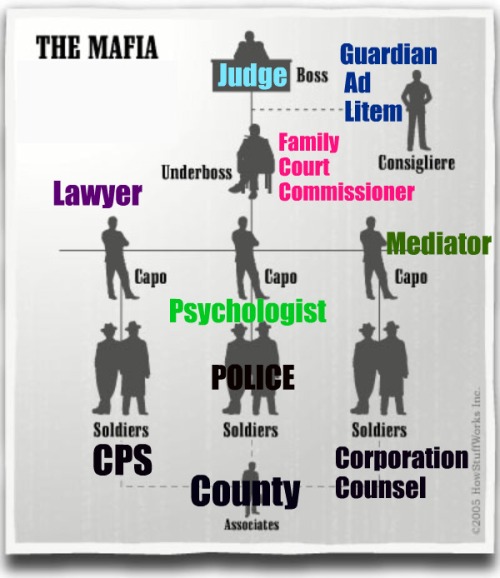
Showing posts with label Family Courts. Show all posts

Monday, November 21, 2011

U. S. Department of Justice v. Custody Court System


By Barry Goldstein

Protective mothers have been complaining about mistreatment by the custody court system, but have routinely been dismissed as “disgruntled litigants.” As recently as the beginning of the Battered Mothers Custody Conferences in 2004, there was little professional support for protective mothers. The mothers’ complaints have now been confirmed and supported by the domestic violence community, many women’s organizations, numerous governmental agencies, many in the academic community and a substantial body of research such as contained in our book DOMESTIC VIOLENCE, ABUSE and CHILD CUSTODY.

Last summer at the NCADV Conference, Dr. Daniel Saunders of the University of Michigan and some of his colleagues presented their findings from a major Department of Justice study that confirms the findings in our book and other research that the present custody court practices for domestic violence cases are deeply flawed. The publication of these findings has taken longer than expected as Dr. Saunders and the Justice Department seek to carefully present the information in a clear and accurate manner, but they should soon be available on the Department of Justice web site. Many of us who seek to reform the broken custody court system are excited about this study because it should be difficult for the courts to dismiss or ignore because of where it comes from. Significantly, the findings are incompatible with a continued belief that the present practices are working for the benefit of the children the courts are supposed to protect.

Custody Courts Frequently Disbelieve Valid Abuse Complaints

Custody courts have a particularly poor record in responding to domestic violence cases. The research demonstrates that court professionals reject a high percentage of valid complaints by protective mothers. This problem has been confirmed in many ways. It is confirmed based on the frequency of mistaken outcomes. Although battered mothers make deliberately false allegations only one or two percent of the time, in contested custody cases the alleged abuser wins custody or joint custody over seventy percent of the time. Subsequent events regularly confirm courts’ mistakes. This occurs when men found safe by the court professionals are later convicted or otherwise found to have to have committed domestic violence, sexual abuse, murder or other similar crimes.

The revelations of the Courageous Kids Network further demonstrate the frequency in which courts fail to recognize valid complaints of abuse. Courageous Kids are young adults who have aged out of their custody orders and decided to speak out about the harm caused by these orders. The context is important in understanding their stories. These are cases in which the court disbelieved the mothers’ abuse allegations and gave the fathers complete control. The children have been threatened, coerced and punished if they continue to complain about their father’s abuse or seek a relationship with their mother. In other words the fathers have had tremendous assistance in silencing the children. Accordingly the children now speaking out represent a small minority of those mistreated by fathers the court believed were safe. The descriptions by the Courageous Kids demonstrate the fathers deliberately sought to hurt the mother and children based upon their belief system that the mother had no right to leave them. The children have had little or no contact with their mothers often for many years so we know the mothers could not be influencing the children’s decision to speak out about the fathers’ abuse. These are all too common examples of cases in which the court professionals failed to believe valid allegations of abuse.

The research not only demonstrates the fact that the custody courts get a large majority of domestic violence cases wrong, but also that the standard practices used by court professionals are deeply flawed and make it difficult for judges to recognize legitimate complaints about domestic violence and child abuse.

Court professionals routinely discredit allegations of abuse based upon factors that are not probative. At the same time these professionals do not understand the importance of looking to the abusers’ patterns of controlling and coercive behavior in order to recognize domestic violence. The court professionals often make the mistake of considering each incident and each allegation separately. Genuine domestic violence experts understand the importance of context in recognizing domestic violence, but the mental health and other professionals relied on by the courts do not understand the importance of context and thus make it more difficult to recognize valid allegations of abuse.

One of the big obstacles to recognizing valid abuse complaints is the common use of mental health and other professionals without expertise in domestic violence. The main purpose of considering domestic violence in custody cases is to protect the safety of children. Nevertheless the evaluators relied on by custody courts rarely know how to conduct a safety assessment or what behaviors have been associated with higher lethality and other dangers. The evaluators do not understand domestic violence dynamics and often are unfamiliar with the effects of domestic violence on children or other information based upon the specialized body of scientific research that could be used to better understand domestic violence issues and recognize truthful allegations of abuse.

The new Department of Justice study helps explain why the evaluators and other professionals relied on by custody courts routinely fails to recognize domestic violence. The study found that most evaluators and other professionals relied on by the courts do not have adequate domestic violence training and those with inadequate training are more likely to believe in the myth that women frequently make false allegations of abuse to gain an advantage in litigation. The professionals who believe this myth, in turn are more likely to make recommendations that harm children. In other words judges have little chance to protect the children under their control as long as they rely on these unqualified professionals and tend to believe their deeply flawed analysis.

Judges often become defensive when protective mothers or their attorneys request that any evaluator or other court professional be required to have domestic violence expertise in order to be appointed. We have repeatedly seen judges refuse to listen to domestic violence experts offered on behalf of protective mothers. The courts often focus on the need for a mental health degree even though the academic training for most mental health professionals included no or virtually no domestic violence instruction and the law does not require advance degrees to qualify as an expert (a common example is a mechanic without a high school degree who can testify as an expert in automotive repair based on experience and training).

In recent years most court systems have encouraged and usually required some domestic violence training for court professionals. This is a good thing but has often been implemented in ways that undermine the purpose. Many of the trainings include substantial misinformation such as the belief most contested custody cases are “high conflict” when the research establishes a large majority are really domestic violence cases. Some of the trainings even include Parental Alienation Syndrome (sometimes by another name because of its deserved notoriety) even though it was recently again rejected for inclusion in the DSM-V because there is no scientific basis for it. Many of the trainings fail to include domestic violence advocates or other genuine experts in domestic violence.

We have also seen some really good programs used to train court professionals, but I have heard many trainers complain that some of the judges, evaluators and lawyers pay little attention to the valuable information presented. In one Queens County, New York case I cross-examined an experienced evaluator who went to a really excellent domestic violence training in order to qualify as a parent coordinator. They provided numerous excellent research studies that could have helped him recognize domestic violence and protect children. During my cross-examination it became clear he never read the research and was unfamiliar with the current scientific research he needed to understand the case. When I pressed him about the training he described it as “not a life changing experience.” This was a man who needed a life changing experience because he failed to recognize the obvious history of abuse by the father, demanded the mother cooperate with her abuser and when she continued to try to protect herself and her son, the unqualified evaluator recommended custody for the abusive father. The judge failed to discredit the evaluator based on his failure to read or consider the current scientific research provided at the training.

We need much more and better trainings for court professionals, but there is also the danger that attending trainings can give judges and other professionals a false sense of confidence in their understanding of domestic violence. The findings by Dr. Saunders and his colleagues that most court professionals have inadequate training in domestic violence confirms our concern that in most cases the professionals relied on by the court are not qualified to participate in a domestic violence case without the assistance of a genuine expert. Even if the judge has received good training the court is likely to be influenced by unqualified evaluators and other court professionals.

The failure to possess adequate training in domestic violence means that it will be difficult for these professionals to recognize and respond effectively to domestic violence, but the widespread belief in the myth that women frequently make false allegations of abuse is a bias that strongly undermines the cases of protective mothers. These mistakes result in frequent findings denying the mother’s abuse allegations which is exactly what the other research has found. If a professional believes the myth they will expect to see false allegations and without training in how to recognize domestic violence they have little chance to get these cases right and protect the children. Even worse, courts having found against the mothers because of the deeply flawed practices and biases are severely punishing mothers and children because the mothers continue to believe their true allegations despite the disbelief of the unqualified court professionals.

A few months ago, in this forum, I wrote an article about the extreme decisions we often see in domestic violence cases. These are decisions in which the alleged abuser receives custody and the mother who was the primary attachment figure is limited to supervised or no visitation. The primary attachment figure is the parent who provided most of the child care during the first couple of years of the child’s life. When children are separated from their primary attachment figure they are significantly more likely to suffer depression, low self-esteem and to commit suicide when older. It can never be right to separate children from their primary attachment figure unless she is unsafe such as a drug addict, someone who beats the kids or otherwise poses a danger. In most of these cases the father allowed or even demanded the mother provide child care until she decided to leave him. It should be obvious that her decision to leave a man she found to be abusive does not make the mother unsafe. Unqualified court professionals frequently limit the mother’s contact with her children based upon some version of alienation or pathologizing the mother based on psychological tests that were not made for the populations seen in custody cases. We know the diagnosis is not safety related because the mother functions fine in all other aspects of her life except interacting with her abuser and the court professionals supporting him. These are not safety issues so these extreme decisions can never be beneficial to the children.

The reliance on court professionals with inadequate training and belief in the myth takes place in the context of many other common mistakes discussed in earlier research. The courts cannot protect mothers and children in domestic violence cases if they cannot recognize domestic violence when it is present. The frequent decisions that harm children are confirmed by later findings and information, the extensive research court professionals routinely fail to consider and the new Department of Justice study and they provide multiple confirmations of the present inability of custody courts to recognize domestic violence and child abuse when it exists.

Misuse of Mothers’ Anger and Emotion

Let’s look at this issue from the mother’s perspective and in the context of her experience. These are domestic violence cases. The father usually has a long history of controlling and coercive behaviors and the mother has finally gained the courage and resources to leave her abuser in order to protect her children. She is fearful because of the many threats he made of what he would do if she left and knowledge that the most dangerous time for a woman is after she has left. She is angry at the way he has mistreated her and often the children. She may be worried about her ability to support and protect her children because her partner has been telling her how useless she is throughout their relationship.

Even if the father’s physical abuse ends when he no longer has access to the mother (which makes unqualified court professionals believe he is now safe), he continues his domestic violence through litigation abuse and often other ways. The abusers often use any contact provided by the court to seek reconciliation and/or to harass and attack her verbally or psychologically. Many women expect the courts to protect her children because the evidence is so overwhelming and instead find the court pressuring her to cooperate with her abuser and punishing her if she tries to protect her children from a man they have found to be hostile and dangerous. In other words she has good reason to be angry and emotional and in fact this would be a normal reaction to her experiences.

The research contained in our book and elsewhere supports this understanding and analysis. We discussed the common mistake of custody courts that treat the mother’s actions as a litigant as if they were an indication of her behavior as a parent. Over forty states and many judicial districts have created court sponsored gender bias committees. These committees have found widespread bias particularly against women litigants. One of the common examples of gender bias was blaming women for the actions of their abusers. One of the typical examples of this bias is when courts blame mothers for their anger and emotion caused by the father’s mistreatment of them and their children. In many cases the abusers deliberately harass or pressure them shortly before a court appearance is scheduled in order to obtain an emotional reaction the court is likely to misunderstand. Abusers tend to be extremely manipulative and so after their abuse that the judge does not see, come to court calm and cooperative. Court professionals are often fooled by this act.

The new Department of Justice study confirms what we said in our book and other similar research. Dr. Saunders found that court professionals frequently treat mothers’ anger and emotion as far more important than it actually is in terms of the well being of children. These professionals may be uncomfortable with the mothers’ emotions particularly if she criticizes their response to the father’s abuse. Clearly these are difficult and unpleasant issues to confront. The misinformation treating contested custody as if it were “high conflict” when it is actually domestic violence contributes to the misunderstanding of the mothers’ anger and emotion. The professionals are focused on forcing the parties to cooperate even though this is not the best approach for children. When the parties have difficulty cooperating and certainly in domestic violence cases, parallel parenting is a more effective approach for children. The problem, as demonstrated by the Saunders’ study is that these professionals are focused on their beliefs and preferences rather than research about what works best for children. The custody courts did not get into the practice of looking to current scientific research and particularly the specialized body of research about domestic violence because there was no such research when the initial court practices were developed. We now have substantial research that would help inform court decisions and avoid the frequent mistakes but court professionals rarely look to this research to help them make better decisions. This is why we rarely see custody courts weigh the benefits and harms to children of a proposed resolution. The Department of Justice study establishes that these flawed practices lead to decisions that hurt children.

Cottage Industry Supporting Abusive Fathers

We often hear complaints about corruption in the custody court system. This belief is supported by the many cases in which courts make findings that are far removed from a fair evaluation of the evidence and decisions that seem to be disconnected from the well being of the children involved. There are cases of outright corruption such as the Garson case in Brooklyn, New York, but more often, I believe courts create the appearance of corruption because of bias, ignorance and deeply flawed practices. One of my concerns with complaints about corruption is that it makes it harder for judges in the broken system to hear the complaints and create the reforms that are needed. An important contributing factor to the widespread belief in corruption is the cottage industry that has been created to support abusive fathers.

Most contested custody cases involve abusive fathers seeking custody as a tactic to pressure their victims to return or punish them for leaving. Domestic violence is all about control so these abusive fathers usually have controlled the family finances and have these resources to support their custody litigation. Some lawyers and mental health professionals have figured out that they can make a large income by supporting practices and approaches that support abusers. We often see them advertise as supporting “fathers’ rights.” In many cases we see fathers’ attorneys and GALs promoting the appointment of evaluators who support abusive fathers. It is particularly frustrating when judges refer to these professionals who regularly support abusers as “neutral professionals.”

Protective mothers often have no chance when these biased professionals are appointed regardless of how strong their cases may be. Many of the mothers have complained that the evaluators and GALs make misrepresentations to the court in order to justify findings in favor of the abusive fathers paying their fees. When such professionals lie to the court about the evidence or to justify fees they did not earn, the mothers are justified in complaints suggesting corruption.

Many of these biased professionals strongly support PAS despite a lack of scientific justification. Significantly, PAS is based upon the assumption that virtually every complaint by mothers about the father’s abuse is deliberately false. The Department of Justice study found a problem with inadequately trained professionals who believe the myth that women frequently make deliberately false allegations of abuse. The unqualified professionals supporting PAS are even worse assuming that virtually all such allegations are false. The courts have virtually no chance of making the right decision if they treat such biased professionals as having any credibility.

The Department of Justice study’s contribution to this issue is a finding that evaluators working for the court or the county made recommendations that worked better for children than those of evaluators in private practice. When Dr. Saunders described this finding at a workshop during the NCADV Conference I asked him if he thought the findings supported our concerns about the cottage industry that has developed to support abusive fathers. He agreed this was a good interpretation. Evaluators working for the court or county are not paid extra for each evaluation so they have no incentive to favor the wealthier parent.

Professionals often have fundamental conflicts of interest. Medical doctors who schedule tests or procedures will earn money from performing the services they recommend. Tests may be scheduled to shield the doctor from potential lawsuits rather than to benefit the patient. Lawyers who recommend going to trial, starting a lawsuit or making a motion will earn money when the client takes their advice. Similarly, mental health professionals benefit financially when patients accept recommendations for more services. The conflict of interest is largely unavoidable and the professionals are expected to have the integrity to act in their client’s best interests instead of their own. Unfortunately some of the evaluators and lawyers, particularly those supporting abusive fathers have not fulfilled this ethical obligation.

We have repeatedly seen problems in custody courts with mental health professionals and particularly ones sympathetic to abusive fathers making recommendations requiring protective mothers to use their unwanted and unneeded services. We see these biased professionals pathologizing mothers who have always taken good care of their children with diagnoses that are clearly wrong. This would include the frequent finding of rare conditions such as Munchausen Syndrome by Proxy, conditions like paranoia or delusional based on the mothers’ continued belief in the father’s abuse despite the failure of the court professionals to recognize his abuse and other emotional problems that magically seem to affect only her relationship with her abuser and the court. They seem oblivious to the fact that that she does fine in other parts of her life that under any unbiased circumstances would rule out the claimed diagnosis.

Some of these mistakes are clearly deliberate and qualify as corruption. Other cases may involve bias and ignorance and a lack of the needed qualifications as the Saunders’ study demonstrates. When the professionals who are part of the cottage industry engage in gender bias they usually do so without realizing it. Many actually believe in the theories and practices they use despite a lack of scientific basis. Some of this can be explained by confirmation bias where the professional focuses on information or accusations that support what the professional expects to find and ignores information that undermines their theories and assumptions. We see this kind of mistake frequently in domestic violence custody cases and the mental health professional is often unconscious that they are engaging in confirmation bias. In fact they are likely to become defensive and angry at the suggestion. The Department of Justice study demonstrates the harm of using professionals who are part of the cottage industry and the need for custody courts to screen court professionals to avoid relying on them. Even worse, courts often use these unqualified professionals to train other court professionals. This can only serve to spread misinformation which makes it harder for court officials to recognize the problems demonstrated by the Saunders’ study and other current scientific research.

Conclusion

The custody court system tends to look at each case and each issue or event in a case separately. This is based on a belief that just because a man slapped his wife on Monday does not mean he punched her on Friday. The court system uses stare decisis which means once a case or an issue has been decided the same parties cannot relitigate it. There are good reasons for these practices, but they work poorly in domestic violence cases because of the importance of context in understanding domestic violence. We often see cases where the court denies allegations of domestic violence and they may even have been right if there was insufficient evidence. Naturally the abuser continues his abusive behavior so more evidence becomes available, but many courts refuse to hear the new evidence or refuse to consider it in the context of the previous evidence because those issues were previously litigated. In doing this the court is denying itself the ability to recognize the pattern of the father’s abuse and protect the children. Domestic violence experts are confident that the custody court system is broken because we see the pattern of mistakes and harmful decisions, but the powers in the court system are offended at the criticism and cannot believe the problem because they refuse to look at the patterns.

The findings of the Department of Justice study, by itself, provides convincing documentation that the custody court system is getting a large majority of domestic violence custody cases wrong. It would be impossible for courts to get most cases right when most of the court professionals have inadequate domestic violence training, those with inadequate training tend to believe the myth that women frequently make false allegations, the courts are placing too much weight on mothers’ anger and emotion and the evaluators who earn additional money through appointment in custody cases are making decisions more harmful to children then those who do not have a financial incentive. This study was not made in a vacuum, but was produced in the context of a substantial and growing body of scientific research that establishes the custody courts are making bad decisions in contested custody cases that endanger children. The research also establishes that the standard practices used in the custody courts are deeply flawed and outdated.

I am hopeful that a study coming from the U. S. Department of Justice will be harder for the custody court system to ignore. They have a strong reputation and can only be considered neutral. Furthermore, the courts frequently seek grants and other funding from the Department of Justice. Protective mothers and their attorneys can cite this research and it should be harder for the courts to ignore. I can’t wait until it is published on the DOJ web site.


Barry Goldstein is a nationally recognized domestic violence expert, speaker, writer and consultant. He is the co-editor with Mo Therese Hannah of DOMESTIC VIOLENCE, ABUSE and CHILD CUSTODY. Barry can be reached by email at their web site www.Domesticviolenceabuseandchildcustody.com

Tuesday, November 9, 2010

Domestic Violence Safe Courts Act


By Barry Goldstein

Even when things are going well personally and professionally, you can't work on protective mother issues without regularly receiving a cruel jolt of reality from the broken court system. I just received such a jolt with the mistaken conviction of a protective mother for perjury regarding her complaints about her abuser's assault. Surely the jury could have made a better decision if they could have been told of the context that courts routinely fail to recognize domestic violence and avoided the myth most people have heard that women frequently make false allegations of abuse.

This is a classic case from the Binghamton area of New York that I used as an example of common mistakes in the custody courts in my chapter for our book. In the chapter by Judge Thomas Hornsby, he explained how in his 19th year on the bench he learned the right way to respond to certain kinds of petitions for protective orders. It takes a great deal of courage and integrity to acknowledge this need for further learning, particularly in domestic violence cases. Instead, the judge in Binghamton said he had been on the bench for fifteen years and didn't need to hear the testimony of a domestic violence expert (me). He then sent the children to live with their abusive father.

The mother in this case has spoken of the high price she must pay for trying to protect her children. She had suffered the loss of her children and knowing they are continuing to suffer abuse. She has been ruined financially and for the second time faces bogus criminal charges and jail. And so in honor of this dear friend and all the too many other mothers in similar circumstances, I would like to propose legislation to make it safe for battered mothers and their children when they come to court. Repeatedly, protective mothers come to court confident that the judge and other court professionals will protect them from their abusers, since the evidence as far as the well-being of the children is so clear. And repeatedly, the inadequately trained court professionals, relying on outdated information and discredited practices, most of which were adopted 30+ years ago at a time when no research was available, instead helps the abuser to maintain control over his partner and to punish her for revealing his abuse. For years we have debated solutions to these repeated tragedies, but before any reform is possible, we must make the courts safe for battered women and their children.

The Importance of Findings 

While findings do not have the force of law, they do explain the purpose of the law and the intent of the legislature. It is totally appropriate and advisable for attorneys and protective mothers to cite such findings in support of their interpretation of the law, and such considerations should be persuasive.

The findings should state very directly that the present court response is working poorly for women and children in domestic violence custody cases and that the intent of the legislature is to create fundamental changes in the way courts respond to such cases. The intent of the legislatures when they passed laws requiring courts to consider domestic violence in custody and visitation decisions was for the courts to take domestic violence seriously, based on the research that demonstrated the severe harm to children of witnessing abuse, but the outdated and discredited practices widely used in the court system have undermined the courts' ability to provide the protections and safety the legislatures thought they were creating.

The courts frequently fail to recognize valid complaints about domestic violence. Court professionals often do not have adequate training in domestic violence and often rely on mental health professionals who have little or no training or understanding about the dynamics of domestic violence. There are many normal behaviors by battered mothers that inadequately trained professionals use to discredit allegations of abuse that are not probative. At the same time courts often limit their focus to physical abuse and fail to use the evidence available to recognize the pattern of controlling and coercive behavior. Best practices require that professionals without extensive training in domestic violence (which is almost all of the professionals used in the custody courts) should consult with domestic violence advocates or other experts. Courts rarely use such best practices, and many judges, like the judge in the Binghamton case, mistakenly believe that several years on the bench is an adequate substitute for genuine expertise and familiarity with up-to-date scientific research.

The courts' response to allegations of child sexual abuse is particularly harmful. Sexual abuse is hard to prove because, for obvious reasons, there are rarely any witnesses except for the child. Young children may not have the language to describe what happened; older children are often reluctant to reveal the abuse because of threats or just out of loyalty to their abuser. Inadequately trained professionals often expect physical proof, but many forms of sexual abuse leave no physical evidence, and the delay before a child reveals the abuse may cause physical evidence to be unavailable. These professionals often expect children to discuss very painful and embarrassing events without taking the time to create a trusting relationship and to use play therapy or other techniques that work best with younger children. Experts know that children often recant valid complaints, but recantations are routinely treated as if they were convincing proof the mothers made deliberately false reports.

In an attempt to treat all parties fairly, courts often believe they must treat the parties the same. This is often expressed in the view that when parents come to court they must be treated equally. What is left out is any consideration of PAST PARENTING PRACTICES.. There is a difference between men and women, particularly in a society that continues to provide unearned yet often invisible privileges to men. Considering the differences between men and women is not unfair to men, but failing to consider them is unfair to women. The refusal of courts to speak of these differences, despite widespread gender bias confirmed by commissions sponsored by courts in over forty states and other research, results not in fairness or equality of how the courts treat the parties but in a huge advantage to men, especially abusive men.

Probably the biggest advantage given to fathers in custody cases stems from the widespread myth that women frequently make false allegations of abuse. A recent Department of Justice Study led by Dr. Daniel Saunders shows that evaluators with little training in domestic violence tend to believe this myth and thus make recommendations that work poorly for children. Of course, these false assumptions are often hidden from the judge, but if we don't speak openly about the difference between men and women, the biases in favor of men will continue to make the courts unsafe for women and children.

At the same time, studies, particularly one led by Nicholas Bala, establish fathers in contested custody cases are sixteen times more likely than mothers to make false allegations against the other parent. I want to be clear that this is not to say women in general are more honest than men; rather, this is limited to what goes on in contested custody cases. A large majority of fathers in such cases are abusers who are using the custody tactic to maintain control over former partners. It is based on the belief that she has no right to leave, so therefore, the use of any tactic, including raising false allegations, is justified. This is particularly important for prosecutors and child protective workers to realize, so that they don't place the resources and authority of the government on the side of abusers.

This problem is particularly exacerbated by the ability of abusers to manipulate other people, including professionals. Those who believe they have the ability to tell who is lying just by observing them are at even greater risk of being manipulated.

One of the fundamental mistakes made by the court system is treating contested custody cases as "high conflict," which implies that both parties are acting out their anger towards the other party through the children. In fact, most of these cases are domestic violence cases. The courts have adopted a lot of practices designed to encourage the parents to cooperate and to bring the parties together. Abusers love this, because it means forgetting about past history (his abuse) and gains him access to his victim. When mothers resist cooperating with someone who has hurt her and her child, she is viewed as unfriendly and often is severely punished. This is a prime example of blaming the mother for the actions of the father, something repeatedly uncovered by the state gender bias reports. The research establishes that the only methods that have been shown to change abusers' behavior are accountability and monitoring, but the courts, which are not used to looking to up-to-date research for answers, are doing just the opposite.

Needed Changes in the Law and Priorities 

One of the problems in the court system is that the standard "best interests of the child" standard is subjective and often leads to focusing on less important issues. Most states have laws or case decisions that enumerate issues the court must consider in deciding custody and visitation. Courts often focus and decide custody based on cooperation between the parties, negative statements about the other parent, financial considerations, quality of the house or apartment or other similar issues. It is not that these are not valid issues that should be considered in appropriate cases, but too often these kinds of issues trump issues that are vital to the well being of the children. The first priority must be the safety of the children. DUH! It is frightening how often this is not the priority. When there are safety issues, we need a risk assessment rather than a traditional evaluation that focuses on less important issues and often doesn't have the understanding to recognize the risks. The second priority should be arrangements that give children the best chance to reach their potential. It is hard to imagine anyone seriously objecting to these priorities, but it is not what the courts are doing today.

The research about primary attachment is not controversial. Whichever parent provides most of the child care during the first couple of years of the baby's life is the primary attachment figure and this does not change even if the living arrangements do. A child separated from their primary attachment figure is at greater risk of depression, low self-esteem, and suicidality when older. It cannot be right to impose these risks on a child unless the primary attachment figure presents a safety risk, such as someone who is a drug addict or beats the child. Negative statements about the other parent do not pose such a safety risk and have not been shown to create the long term harm of losing the primary attachment figure, but courts routinely place more emphasis on negative remarks because they have been taught to view the cases as "high conflict."

The range of harm to children from witnessing domestic violence is even greater. Such children are at increased risk for engaging in a wide variety of dysfunctional behaviors that can ruin their lives. Furthermore, domestic violence is based on a belief system so the end of a relationship is not likely to make the abuser safe. He will probably abuse future partners, so the children will witness further domestic violence if he is given custody or unsupervised visitation.

Training in domestic violence for court professionals has been a common component of the courts' response to domestic violence for many years, yet still the courts are getting a large percentage of domestic violence cases spectacularly wrong. Many judges and other professionals don't attend such trainings or don't pay attention out of a belief they already know everything or hostility to the topic. Too often the trainings have included misinformation that makes the situation worse while creating the illusion of addressing the problem.

The research that shows the frequency with which fathers in contested custody cases kill their children, often with the unintentional assistance of the court, or receive custody and unsupervised visitation despite a history of abuse ought to create an urgency for changing the status quo. The Safe Court Act must provide for the retraining of judges and other court personnel. Common misconceptions like the myth women frequently make false complaints, domestic violence ends when the parties separate, children are unaffected by witnessing abuse and mistaking domestic violence cases as "high conflict" must be addressed and corrected. Then, instead of general domestic violence training, specific topics must be taught including Recognizing Domestic Violence, Gender Bias, Effects of Domestic Violence on Children, Critical Thinking About the Use of Mental Health Professionals and More Appropriate Responses to Allegations of Child Sexual Abuse. Finally, such trainings should be sponsored or co-sponsored by an organization whose primary focus is ending domestic violence.

At the start of the movement to end domestic violence, the focus was mostly on physical abuse. But the harm to women and children is not limited to physical abuse, so there is no reason to limit the definition of domestic violence when making custody decisions. Domestic violence should be defined as a pattern of intimidating, controlling and coercive tactics by one party designed to permit that party to control their partner and make the major decisions in the relationship. These abusive actions result in the victim becoming afraid of the abuser.

Domestic violence experts are clear that in cases involving domestic violence as defined above, the best outcome for the children is custody for the non-abusive or less abusive parent and at least initially supervised visitation for the abusive parent. While many states have a presumption for this child-friendly outcome, too often it is limited by higher standards of proof or level of abuse. The harm to children is not limited to what is considered more severe abuse so there is no reason to continue such limitations on protecting children.

Particularly harmful to children is the common practice where the court fails to confirm the mother's allegations of abuse and then punishes or retaliates against the mother if she continues to believe the father is dangerous despite the court's finding. We found that when the court confirms a father's abuse, it does not further penalize him for continuing to deny his abuse, even though his continued denial is far more harmful than the mother's expressed fear of the father. This practice is bad because of the frequency that courts fail to recognize valid allegations of abuse; the harm of taking the primary attachment figure out of a child's life is far more harmful than any benefit the court thinks it is creating. The law must provide that parents will not be penalized for good faith allegations, and the practice of denying children a meaningful relationship with safe, protective parents must be discouraged.

Abusers tend to control the family finances and often use the family resources for legal and other resources while denying the same benefits to the victim. This is exacerbated by a common abuser tactic of using aggressive litigation strategies to bankrupt the victim. Courts must be encouraged to act more assertively to level the playing field by making the person controlling the family funds also provide funds for the other parent's legal needs. This will lead to fairer outcomes and discourage excessive litigation, since the abuser doesn't benefit from excessive motions if he has to pay for both lawyers.

The research is very clear that women rarely make false allegations of abuse. They do so only one or two percent of the time, but there is a widespread myth that abuse claims are frequently false. At the same time, fathers involved in contested custody cases are sixteen times more likely to make false allegations. Prosecutors, in particular, need to be trained about this common tactic so that they can avoid being manipulated to help an abuser continue his abuse as the prosecutor in the Binghamton case mistakenly did. Similarly, child protective workers, lawyers and judges need training with this information. We have seen many child protective workers refuse to investigate allegations by mothers involved in contested custody cases on the (false) assumption she is trying to gain an advantage in the litigation, but take seriously (false) allegations by fathers involved in contested custody. Obviously, each case must be investigated separately, but they need to be familiar with the research so they can understand the context.

Many communities have developed practices where child protective agencies work together with the local domestic violence agency. They cross-train each others' staffs and when child protective caseworkers have a case that may involve domestic violence, the worker consults with a domestic violence advocate. This has resulted in a greater ability to recognize domestic violence and respond in ways that benefit children. This should be considered best practices. Similarly, ethical considerations require psychologists and psychiatrists to consult with experts in areas they are not familiar with. Few court-appointed mental health professionals are experts in domestic violence but they rarely consult with domestic violence advocates or experts and courts do not discredit them for failing to do so. The law should require such consultations which must be understood as best practices.

The research shows the widespread use of mental health professionals in contested custody cases is problematical. Psychologists rely on psychological tests that were not created for the populations seen in custody courts and are based on probability, so that under the best of circumstances the results apply to only 55-65% of the parties, but this percentage is even lower in cases involving domestic violence. Frequently, we see mothers discredited because of results that show defensiveness, fear and other normal reactions to their partner's abuse. When courts fail to recognize the abuse, mothers are pathologized as paranoid or delusional when there is no pathology in other parts of their lives. Accordingly courts must use much more critical thinking in the use of mental health professionals. This expense and delay should only be used when there are genuine mental health issues involved in the case. In cases involving allegations of domestic violence or child abuse, a risk assessment using probation or other investigators and domestic violence experts familiar with lethality risks would be more useful.

Courts can save substantial time and money by having an early evidentiary hearing on allegations of domestic violence. The sole issue is whether the allegations are valid. If they are, the non-abusive or less abusive parent receives custody and the abuser initially receives supervised visitation. There is no need for evaluations, GALs or the consideration of less important issues that often distract attention from issues that most affect children. Cases that now take many months or years can be resolved in a few hours and children will quickly know who they will be living with which allows them to start the transition and healing process more quickly.

Conclusion 

We have a court system that is failing to protect battered mothers and their children because they are relying on outdated and discredited practices and beliefs that were developed at a time when no research was available. Every year, the custody courts are sending 58,000 children to abusers for custody or unprotected visitation. And every year abusive fathers involved in contested custody cases kill at least one hundred precious children, often with the unwitting assistance of courts using these standard flawed practices. Legislators and judges cannot justify continuing practices that are working so badly for our children and must operate with an urgency to reform the broken system.

These outdated and discredited practices have allowed abusers to enlist the court system to help them maintain control over their victims after they try to leave and in many cases courts continue the abuse by punishing mothers trying to protect her children. We have examined thousands of disturbing cases like the one in Binghamton where safe protective mothers are severely punished in retaliation for attempting to protect their children. The mothers lose custody and often are restricted to supervised or no visitation. They face financial ruin, court sanctions, contempt and even jail. Many prosecutors like the one in Binghamton are manipulated by abusers to bring bogus charges against protective mothers. A review of these extreme outcomes demonstrates that these decisions are almost always wrong.

Urgently, we need a law to make it safe for protective mothers to come into our courts. Our courts and our laws were designed to provide safety for battered women and we must make this true in practice instead of just theory. We must make sure that the court system can no longer be used and manipulated by abusers to retaliate and punish mothers for the crime of seeking to keep their children safe.

Barry Goldstein is a nationally recognized domestic violence expert, speaker, writer and consultant. He is the co-editor with Mo Therese Hannah of DOMESTIC VIOLENCE, ABUSE and CHILD CUSTODY.


DOMESTIC VIOLENCE SAFE COURTS ACT 

WHEREAS: The custody court system is broken resulting in thousands of children being sent for custody or unprotected visitation with abusers and hundreds of children and battered women being murdered because of the frequency with which courts fail to recognize the common abuser tactic of seeking custody in response to their victim leaving as a way to maintain control or punish her for leaving, and

WHEREAS: The custody court system adopted practices to respond to domestic violence when it first became a public issue and no research was available. These standard practices work poorly for children but have become deeply ingrained so that the courts continue to rely on outdated and discredited practices that hurt children, and

WHEREAS, The custody courts routinely fail to recognize valid allegations of domestic violence because they discredit the charges based on normal responses victims made to the abuse and fail to look for the pattern of coercive, intimidating and controlling behavior that experts understand is the hallmark of domestic violence, and

WHEREAS, The custody court system does a particularly poor job in responding to allegations of child sexual abuse rejecting 85% of such allegations although a majority of the allegations are true. These mistakes are caused by the widespread use of poor practices and bias and the reluctance to believe someone successful in other parts of their lives could do something so heinous. The courts exacerbate this common mistake by frequently retaliating against safe, protective mothers who made good faith allegations of abuse by denying the children a meaningful relationship with their mother, and

WHEREAS, Research establishes that court professionals with inadequate training in domestic violence routinely rely on the common myth that women frequently make false allegations of abuse to gain an advantage in the litigation. Courts usually fail to discredit professionals who rely on this harmful myth, and

WHEREAS, Research establishes that a large majority of contested custody cases cannot be settled because they involve abusive fathers, custody courts have been taught to treat these cases as "high conflict" by which they mean both parents are acting out of anger at their ex-partner and hurting the children in the process. This faulty assumption leads to courts failing to recognize the domestic violence and punishment of mothers for trying to protect themselves and their children, and

WHEREAS, Research establishes that fathers in contested custody cases are sixteen times more likely than mothers to make false allegations than mothers, court personnel are usually ignorant of this research and manipulated by abusers to believe false allegations. Prosecutors, judges, child protective caseworkers and other similar professionals need training to avoid being manipulated to help abusers continue to punish their victims, and

WHEREAS, There are real and legitimate differences between men and women particularly with respect to domestic violence and parenting. Repeatedly, courts have misconstrued the policy to treat mothers and fathers equally to mean regardless of past parenting. If one parent has provided most of the child care and is the primary attachment figure or one parent has been abusive, it is not in the best interests of the children to treat the parents equally, and

WHEREAS, As a result of these and many other common mistakes and outdated practices, the court system has made it unsafe for protective mothers and their children to seek assistance of the courts to protect them from abusers. This law is designed to change the failed practices in order to make sure victims of abuse will be safe in our court system and not subject to retaliation for trying to protect themselves and their children.

1. Definition: For purposes of custody and visitation determinations and consistent with the harm caused to children in witnessing domestic violence, domestic violence are tactics one intimate partner engages in against the other intimate partner. The purpose of the tactics is to coerce, intimidate and control the abuser's partner so that the abuser can make the major decisions in the relationship. Domestic violence is not limited to physical assaults and includes emotional, psychological, financial and litigation abuse. Most domestic violence is legal, but effects children negatively so that the courts should consider these tactics. Domestic violence also includes tactics to isolate the victim from friends, family and professionals who might provide support and assistance. Context is critically important in understanding domestic violence and acts that look the same may be very different because of the context and affect of the tactics. Court professionals must look at the pattern of domestic violence tactics in order to recognize domestic violence and consider which partner is afraid of the other partner as a result of the abusive tactics.

2. The best interests of the child: The first priority in custody and visitation decisions shall be the safety of the child. Risk assessments and lethality studies are more useful in considering a child's safety than traditional evaluations. The second priority in custody and visitation decisions shall be arrangements that give the child the best opportunity to reach their potential Research establishing the long term harm for children who witness domestic violence or to be separated from their primary attachment figure provide the kind of information needed to properly consider what arrangements are most likely to help children reach their potential.

3. Any court considering custody, visitation, orders of protection, criminal, tort or any other issues that involve a determination of whether domestic violence was committed or the proper response to domestic violence shall look at the specialized body of knowledge and research available such as contained in DOMESTIC VIOLENCE ABUSE and CHILD CUSTODY, co-edited by Mo Therese Hannah and Barry Goldstein, THE BATTERER AS PARENT, written by Lundy Bancroft and Jay Silverman, the Department of Justice Study led by Daniel Saunders, the many books and articles cited in these works, and other similar examples of scientific research about domestic violence particularly in the context of child custody. If a court uses expert testimony or reports in such cases, such experts shall be expected to be familiar with this up-to-date research about domestic violence. Such experts will either possess substantial expertise about domestic violence or consult with someone who has such expertise.

4. Any court professionals with responsibility for cases that involve issues related to domestic violence shall undergo retraining concerning domestic violence. Such retraining will include information about common mistakes made as a result of using the common outdated and discredited practices used in custody and other courts and the harm such practices have caused. The retraining will also focus on avoiding common myths about domestic violence such as the myth women frequently make false allegations to gain an advantage in litigation, that abusers are no longer dangerous after the relationship ends, that only physical abuse affects children and that children always do better with both parents in their lives. The new training shall include how to recognize domestic violence, gender bias, the effects of domestic violence on children, critical thinking in the use of mental health professionals and appropriate responses and practices regarding allegations of child sexual abuse. The required training shall be sponsored or co-sponsored by an organization whose primary function is working to end domestic violence.

5. Based upon the serious harm witnessing domestic violence causes children, most experts recommend that where courts find by a preponderance of the evidence that one party has engaged in a pattern of coercive, intimidating and abusive behavior, the non-abusive or less abusive parent shall receive custody of the children and the abusive parent shall at least initially be limited to supervised visitation. In custody cases in which there are allegations of domestic violence, the court will quickly schedule an evidentiary hearing limited to the issue of domestic violence. There is no need for the appointment of an attorney for the children or an evaluator as the hearing is limited to whether or not the allegations of domestic violence are true. If the allegations are proven by a preponderance of the evidence the non-abusive or less abusive parent shall receive custody and the abusive parent shall initially receive supervised visitation. If the allegations of domestic violence are not proven by a preponderance of the evidence, the court shall remain open to later additional evidence which taken together with the earlier evidence becomes sufficient to establish the allegations of domestic violence.

6. The available scientific research establishes that the only responses that have been shown to change abuser's behavior are accountability and monitoring. Accordingly, anger management, therapy and substance abuse treatment shall not be used in response to abusive behavior, but may be used for other problems. When the court orders supervised visitation in response to a finding of domestic violence, in order to be considered by the court for unsupervised visitation, the offender must complete a batterer program, acknowledge responsibility for the abuse, promise never to commit domestic violence again and express to the children the wrongness of the abusive behavior. If the offender is granted the privilege of unsupervised visitation and commits any further acts of physical abuse to a partner or children, the unsupervised visitation shall be permanently ended.

7. While both parties should always be treated fairly, there are substantial differences between mothers and fathers and the attempt to treat both parties the same by ignoring these differences has led to widespread mistreatment of protective mothers in custody cases. Numerous flawed surveys by researchers unfamiliar with domestic violence have sought to gauge the relative abuse by men and women by counting the hits. In doing so they have missed the fact that men are generally bigger and stronger, hit harder and cause more serious injury. They have missed the fact that men and women hit each other for different reasons. Men hit to maintain control and to make the major decisions in the relationship and women hit in self-defense and to stop his abuse. There are exceptions, but these are the most frequent reasons. Most important it is very common for women to be afraid their partner will hurt or kill her so that she will do what he wants and it rarely happens that men are similarly afraid of female partners. When courts equate a woman's assault in anger and frustration from a long history of abuse with the man's assault as part of a long pattern of coercive and intimidating behavior they misunderstand the case. Similarly in our still sexist society women tend to do most of the child care and are usually the primary attachment figure. When courts ignore these circumstances in an attempt to treat both parties equally, they actually discriminate against the mother. Similarly practices that punish women for their anger or emotion after being abused or allow themselves to be manipulated by abusers further give unfair advantages to men. This is why gender bias committees appointed by courts in over forty states have found widespread favoritism towards men. Courts must be conscious of the difference between men and women and strive to avoid gender bias. As gender bias is often invisible to those engaging in it, judges shall encourage litigants and professionals to express concerns about gender bias and avoid retaliating for such complaints.

8. Financial control and abuse is often an important part of the pattern of abuse. Abusers often maintain an unfair advantage in court by virtue of having control of the family resources. This is often compounded by aggressive litigation strategies designed to bankrupt the victim. Courts shall take appropriate actions to level the playing field so that if one party is using family assets to pay legal and other fees, or has access to other resources, that party shall pay similar expenses for the alleged victim's legal fees.

9. The courts shall use more critical thinking in determining whether to use mental health professionals as experts and to limit them to their areas of expertise. Courts shall not routinely appoint mental health evaluators in all contested custody cases. Such appointments shall be limited to cases where there is credible information to suggest one of the parents has a mental disorder that may interfere with the care of the children or other issues that require mental health expertise. Psychological testing was not created for the populations seen in custody court and shall not be used to make determinations about domestic violence. In cases involving allegations of domestic violence or child abuse, if courts require a professional investigation they shall use risk assessments and lethality studies rather than evaluations.

10. The only profession that works full time on domestic violence issues is domestic violence advocates. It is the policy of this state and of the courts to work to prevent domestic violence. Accordingly domestic violence advocates shall be treated by the courts as a community resource and not as if they were partisans. Communities that have programs where child protective agencies and domestic violence organizations work together have proven that consultation with domestic violence advocates helps the caseworkers recognize domestic violence and make recommendations that work best for children. Court professionals shall consult with domestic violence advocates when considering cases with allegations involving domestic violence.

11. The myth that women frequently make false allegations of abuse is unsupported by valid scientific research, but has been relied on by unqualified professionals in ways that place children in danger. The courts shall discredit any professionals who rely on this sexist myth and avoid appointing them to represent children or conduct evaluations or other services. Any theories based on this myth shall also be discredited.

12. The use of "friendly parent" theories has proven harmful to children because of its frequent use in domestic violence cases. This theory shall never be used in cases involving allegations of domestic violence. Any use of this theory must be modified so that the "unfriendly behavior" applies not just to actions that mothers would be more likely to engage in but also to behaviors more likely to be committed by fathers. Actions like failure to pay child support, failure to cooperate on immigration and visa issues, refusal to supply medical insurance and other similar behaviors must be considered if courts use "friendly parent" theories.

13. The policy in this state and for the courts is to prevent domestic violence. Courts shall do everything in its power to make it safe for victims of domestic violence and their children to come to court. Courts must avoid being manipulated by abusers or to help abusers control or punish their partners for leaving. Prosecutors must obtain training about the common abuser tactic of making false criminal complaints against their victims. Prosecutors should attempt to speak with both sides if practicable and to use their discretion not to use the powers and authority of their office to help an abuser maintain control over the victim. Courts must seek to avoid retaliatory actions against mothers seeking only to protect the safety of themselves and their children. When courts believe the alleged victim has violated laws or orders it must also consider the benefits and harm to children that any action it might consider would have.

14. Large numbers of children are living with abusive and inappropriate parents as a result of common mistakes custody courts have made in response to domestic violence cases. In particular these courts have not relied on up-to-date research and have often relied on inadequately trained professionals. The new research available and recognition of the frequency of serious mistakes in these cases shall be considered a change of circumstances for purposes of petitions designed to correct the earlier errors even if the time to appeal has expired or the appeal failed. The court system may develop expedited, but fair alternate procedures to hear applications for correction of mistakes in earlier domestic violence cases.
Related Posts Plugin for WordPress, Blogger...

Disclaimer

The opinions and information expressed in the individual posts do not necessarily reflect the opinions of each contributor of "Time's Up!" nor the opinion of the blog owner and administrator. The comments are the opinion and property of the individuals who leave them on the posts and do not express the opinion of the authors, contributors or the blog owner and administrator.